Choosing a field knife is a decision that impacts your safety and efficiency during your nature immersions. At TB-Outdoor, a Thiers-based manufacturer inheriting centuries of expertise, we forge tools designed to meet the most extreme demands. Blade size is not just a matter of aesthetics or bulk; it defines leverage capacity, cutting precision, and the weight of your equipment. Whether you are a minimalist bushcraft enthusiast or a survival professional, understanding the dynamics of a 7 cm blade versus a 15 cm model is essential. This technical guide will help you select the mount perfectly suited to your hand and your missions.
Key Points for Choosing Your Blade
- Short blades (< 9 cm): Excellent for precision, fine woodworking, and discreet everyday carry (EDC).
- Medium blades (10-13 cm): The ideal compromise for bivouacking, food preparation, and bushcraft versatility.
- Long blades (> 14 cm): Striking power needed for batoning, clearing, and heavy-duty work.
- Balance: A suitable blade must allow for total control without tiring the wrist during prolonged use.
Why Blade Size Changes Everything?
The length of a blade radically alters the center of gravity and the leverage of your tool. A short knife places the tip immediately close to your index finger, promoting millimeter-perfect control. Conversely, a long blade shifts the weight forward, transforming the energy of your arm into impact force. At TB-Outdoor, we study every millimeter to ensure optimal ergonomics, regardless of the chosen size.
How Does Control Define Your Safety?
The shorter the blade, the more you control the trajectory of the cutting edge. For precision tasks such as stripping bark from a branch or carving a trap, a small blade limits the risk of accidental slippage. The proximity between the hand and the cutting area allows for direct transmission of force without lateral torsion. This is the very essence of the technical tool that becomes a natural extension of your fingers.
What is the True Versatility of a Cutting Tool?
Versatility does not mean being able to do everything moderately, but being able to handle 80% of situations encountered in the forest. An intermediate blade allows you to split small wood while remaining nimble enough to slice vegetables on a makeshift board. It is the rational choice for those who wish to carry only one fixed tool on their belt without being encumbered by a hatchet or a paring knife.
Is Everyday Carry a Limiting Factor?
The best knife is the one you have with you when you need it. An 18 cm blade is impressive, but its weight and bulk often make it undesirable for a simple Sunday hike. Discretion and carrying comfort directly influence the frequency of use. A compact knife is forgotten in a pocket or on a bag loop, ensuring its presence during an unexpected event.
Small Blades: Advantages and Limitations
Small blades are generally defined by a useful length between 5 and 9 centimeters. This segment is dominated by EDC (Every Day Carry) type knives and precision tools. At TB-Outdoor, we design these models with high-end steels to compensate for their small size with exceptional edge retention.
- Surgical precision: Ideal for carving work or processing small game.
- Absolute lightness: A major asset for ultra-light hiking (ULH) enthusiasts.
- Legality and acceptability: Often better perceived in a social context or during checks, depending on applicable legislation.
- Limitations: Unsuitable for batoning large wood sections and limited reach for protection.
For lightweight hiking, every gram counts. A small fixed blade or a robust folding knife is sufficient for cutting rope, opening freeze-dried pouches, or sharpening a tent peg. It is the tool of technical efficiency. However, as soon as the environment becomes more hostile and the need to process biomass for fire arises, the small blade shows its physical limitations.
Intermediate Blades: The Best Compromise?
Between 10 and 13 centimeters, these blades form the core of the outdoor market. This is where global bushcraft standards are found. This length allows for a tang wide enough to guarantee ultimate solidity, while maintaining perfect balance in hand.
| Characteristic | Technical Detail | Field Advantage |
|---|---|---|
| Ideal length | 11.5 cm | Perfect balance between weight and leverage |
| Recommended thickness | 3.5 to 5 mm | Torsion resistance during batoning |
| HRC Hardness | 57-59 HRC | Edge retention and shock resilience |
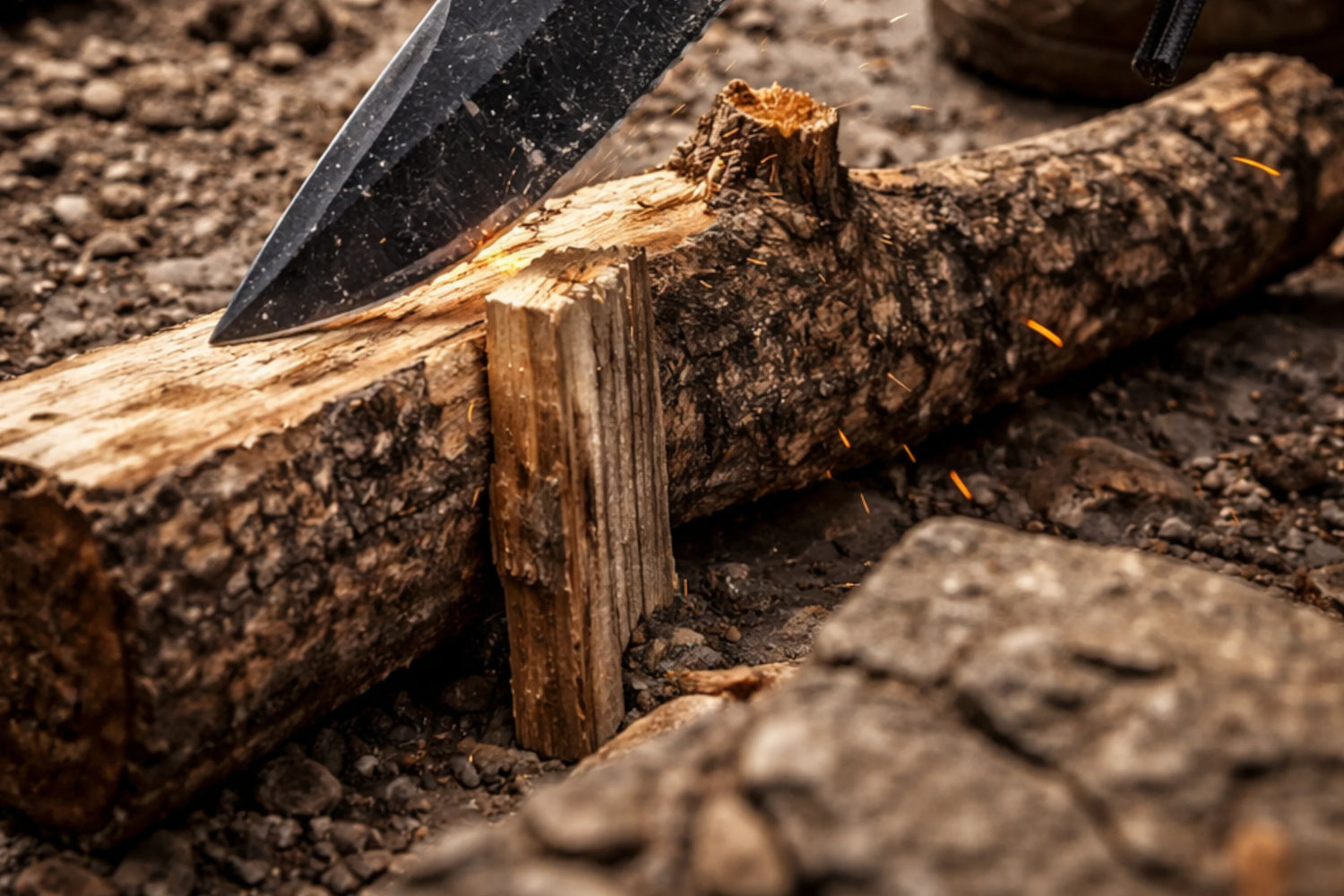
When bivouacking, this knife becomes the all-purpose tool. Its length is sufficient to split logs up to 8 cm in diameter by percussion (batoning) without weakening the steel structure. It is also the standard size for camp kitchen preparation, allowing you to slice bread or meat with natural ease. For us, this is the dimension of trust.
Large Blades: For Which Uses?
Beyond 14 centimeters, we enter the category of camp knives and heavy-duty survival tools. Here, the blade sometimes replaces the hatchet. These knives are designed to withstand extreme mechanical stresses. The blade geometry is often reinforced at the tip to allow for digging or prying.
The primary use of a large blade remains woodworking. Its mass allows for cutting branches by simple impact (chopping). In a demanding environment such as a dense forest or jungle area, a long blade facilitates passage and rapid shelter construction. It is a powerful tool that requires some experience to be handled safely, as the inertia of the blade can surprise a novice user.
- Clearing: Ability to cut brambles or troublesome shrubs.
- Felling: Possibility of cutting small trunks for building a camp bed.
- Impact: Superior kinetic energy for repetitive tasks.
- Precautions: Requires a highly secure sheath and rigorous maintenance of the fastening system.
Which Size to Choose According to Your Practice?
Identifying your user profile is the crucial step. A hunter will not have the same needs as an urban survival practitioner or a summer hiker. At TB-Outdoor, we segment our recommendations so that each tool finds its hand.
| Practice | Recommended Size | Typical Model | Primary Use |
|---|---|---|---|
| Bushcraft | 10 - 12 cm | Robust Fixed Blade | Woodworking, fire, cooking |
| Survival / Military | 13 - 16 cm | Thick Blade | Extreme versatility, leverage, force |
| Hiking / EDC | 7 - 9 cm | Folding or Neck knife | Small tasks, cordage, meals |
| Hunting / Camp | 12 - 15 cm | Wide Blade | Skinning, camp preparation |
For Bushcraft, prioritize control. A knife that is too large will prevent the creation of precise "feather sticks" (tinder shavings). For survival, robustness is paramount: a longer blade allows for splitting larger wood to reach the dry core of the log in case of rain. Finally, EDC requires discretion and accessibility.
Mistakes to Avoid When Buying
The temptation is often great to choose "the biggest" thinking it can do everything. This is a classic mistake. An oversized knife will be tiring to carry, difficult to sharpen in the field, and unsuitable for daily tasks. Conversely, choosing a blade that is too thin or too short to save weight can lead to the tool breaking during unexpected intensive use.
- Neglecting thickness: A long but thin blade is fragile.
- Forgetting the handle: A large blade with too small a handle unbalances the tool.
- Ignoring maintenance: The larger the blade, the larger the surface to sharpen.
- Underestimating weight: An extra 100g on your belt is felt after a 20km hike.
Usage Precautions and Safety
Regardless of the chosen size, a TB-Outdoor outdoor knife remains a Category D weapon and a dangerous cutting tool. Safety begins with respecting fundamental handling rules. A dull knife is often more dangerous than a razor, as it requires excessive force which can lead to slippage.
- Safety zone: Always maintain an arm's length perimeter around you during use.
- Cutting direction: Never cut towards your body or limbs.
- Storage: A knife should be either in its sheath or in your hand. Never left on the ground.
- Prohibited use: Never use the blade as a screwdriver or to strike metal.
Conclusion
Choosing the size of your outdoor knife is a quest for balance between power and precision. At TB-Outdoor, we put our expertise at the service of your adventures by offering tools forged to last. Whether your choice falls on a compact 8 cm companion or a 15 cm titan, the essential lies in the suitability between the steel and your hand. Equip yourself with a tool that respects your practice and will make you forget it until it becomes indispensable. Ready to find your next field ally?
Frequently Asked Questions About Blade Sizes
What is the legal blade size in France for carrying?
In France, carrying and transporting any knife is prohibited without legitimate reason. The blade size does not change the category (D); it is the use and context that determine legitimacy during a check.
Is a 10 cm knife sufficient for batoning?
Yes, a 10 cm blade can baton wood sections up to 6 or 7 cm in diameter. For larger logs, a 14 cm or longer blade is preferable to allow the tip to protrude and be struck.
Why choose a fixed blade over a folding blade?
A fixed blade is intrinsically stronger because it does not have a pivot mechanism, which is a structural weak point. For heavy outdoor use, a fixed blade is recommended for its absolute reliability.
TB-Outdoor Technical Glossary
Tang: The extension of the blade into the handle. A "full tang" means that the steel runs the entire length and width of the handle for maximum strength.
Batoning: A technique involving striking the spine of the blade with a piece of wood to split a log. Requires a robust blade and significant thickness.
Grind: The shape of the part of the blade that tapers to form the cutting edge. It determines the penetration capability and ease of sharpening.