In total immersion, the knife is not just an accessory: it's an extension of the adventurer's hand. At TB-Outdoor, we forge resilient tools capable of meeting the demands of the field, from the Bivouac camping knife to the formidable Maraudeur. Whether you're setting up camp or preparing for an emergency, understanding your blade's potential is key to your autonomy. This technical guide explores the capabilities of our Nitrox® and MOX® steels through the most rigorous scenarios of modern bushcraft.
Field Performance Summary
- Tactical Ergonomics: Secure grip with "trigger" (Maraudeur) or toxified handle (C.A.C.).
- Mechanical Resilience: Ultra-reliable Axis Lock and Full Tang structures.
- Extreme Versatility: Integrated glass breaker, strap cutter, and fire starter.
- Easy Maintenance: Nitrogen-doped stainless steels for easy sharpening in degraded conditions.
What are the main uses for an outdoor knife?
The usage spectrum of a TB-Outdoor blade extends far beyond simple cutting. We design our products to be multi-functional tools capable of withstanding heavy mechanical stresses.
Why is the "Cutting" function the basis of survival?
This is the primary use. Whether it's cutting paracord to set up a shelter or processing game, the edge must be razor-sharp and durable. The Nitrox® steel of our C.A.C. knife offers an ideal compromise between edge retention and corrosion resistance.
How to effectively prepare your environment?
Preparation means clearing an area, cutting branches, or preparing wood shavings to start a fire. A model like the Vengeur, with its 4 mm Tanto blade, excels at penetration and preparing medium-sized wood.
Is shaping accessible with a tactical knife?
Absolutely. Shaping tent pegs, creating notches, or hollowing out a piece of wood to make a spoon requires precision. The control offered by the G10 or paracord handle of the Maraudeur allows for this precision work without excessive fatigue.
Troubleshooting: the knife as a lever and maintenance tool?
In an emergency, your knife becomes a troubleshooting tool. We integrate functions such as the tungsten carbide glass breaker or the interchangeable strap cutter on the C.A.C. to transform the blade into a real anthropogenic rescue kit.
What are the 10 practical uses for hiking or bivouacking?
The field does not forgive improvisation. Here's how our users harness the power of the TB-Outdoor forge during their expeditions.
1. Preparing wood (Batoning and Feathersticks)
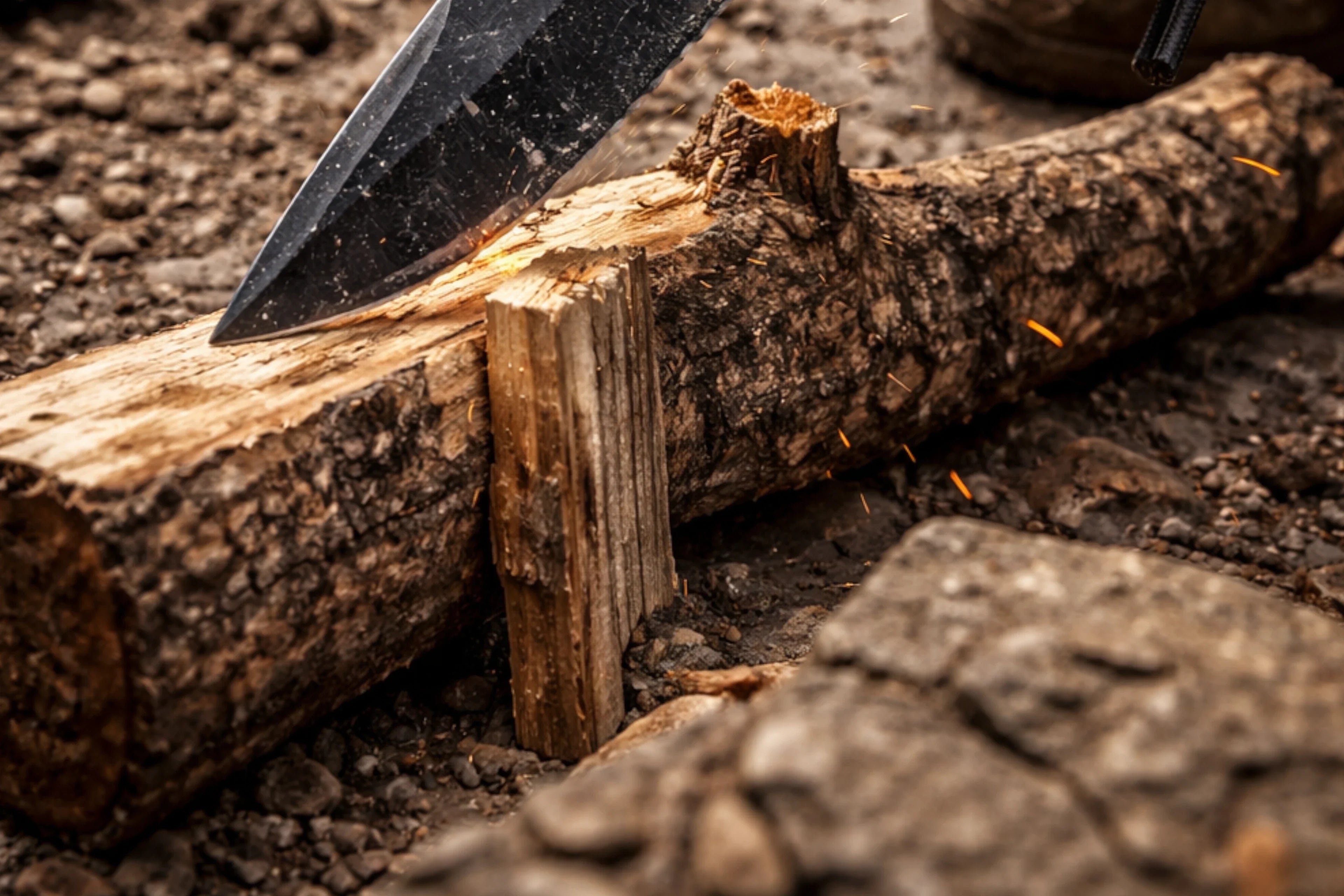
Batoning involves splitting logs by striking the spine of the blade. For this exercise, we recommend a full tang structure like that of the Maraudeur or Vengeur. The thickness of the MOX® steel absorbs shocks without risk of pivot breakage, unlike traditional folding knives.
2. Cutting rope and straps
The use of serrations (micro-teeth) is crucial for cutting fibrous and resistant materials. The C.A.C. offers versions with a combination blade, ideal for cleanly cutting a rappel rope or a safety strap.
3. Opening packaging and sealed materials
When bivouacking, opening rations or equipment packages can dull a low-quality blade. Our PVD (Physical Vapor Deposition) treatments protect the steel against repeated abrasion.
4. Preparing outdoor meals
The Bivouac is the icon of this category. With its patented system integrating a spoon and fork, it transforms every break into a moment of civilized comfort, while guaranteeing an effective edge for meat or vegetables.
| Model | Steel Type | Dominant Use | Weight |
|---|---|---|---|
| C.A.C.® | Nitrox® | EDC / Tactical / Survival | 195 g |
| Maraudeur® | MOX® | Bushcraft / Special Forces | 213 g (G10) |
| Vengeur® | MOX® | ALAT Survival / Extraction | N/A |
| Bivouac® | Hardened Stainless Steel | Camping / Hiking | 150 g |
5. Making small camp accessories
Creating wooden rope tensioners or pot supports requires a blade with excellent "bite". The 17° sharpening angle per side of our knives ensures optimal penetration into wood fibers.
6. Adjusting and repairing equipment
Using the tip of the blade to punch a new hole in a leather strap or to scrape corrosion off a connector. The HRC 58-60 hardness of our MOX® steels guarantees that the tip will not bend at the first lateral effort.
7. Basic camp needs (Fire and Shelter)
Starting a fire by friction or with a fire steel is facilitated on the Vengeur by the presence of a ferrocerium rod housed in the handle. The spine of the blade has sharp edges to generate a shower of sparks at 3000°C.
What are the limits of an outdoor knife?
Even a TB-Outdoor tool is not indestructible if the elementary principles of physics are ignored.
What a knife doesn't replace
A knife is neither an axe nor a crowbar. Although the Maraudeur is extremely robust, using a blade as a lever on rigid materials (steel against steel) can cause micro-cracks or break the tip. For heavy woodcutting tasks, a hatchet remains indispensable.
Actions to absolutely avoid
Avoid throwing knives not designed for this purpose (risk of breaking the locking mechanism on folders). Never heat the blade over a fire, as this can destroy the heat treatment (quenching) and make the steel soft or brittle.
| Constraint | Nitrox® Resistance | MOX® Resistance |
|---|---|---|
| Salt corrosion | Maximum (Nitrogen) | Very high |
| Abrasion (Sand/Soil) | High (PVD) | Maximum (PVD) |
| Mechanical shocks | High | Maximum (Full Tang) |
What type of knife to choose for what use?
The choice depends on your mission profile and the acceptable bulk.
The folding knife: the versatile and compact option
The C.A.C. is the standard of the French army. It's perfect for anyone looking for an "Every Day Carry" tool capable of transitioning from office to forest without interruption. Its reversible clip and ambidextrous opening make it a model of ergonomics.
The fixed blade knife: for absolute resilience
The Maraudeur and Vengeur are designed for intensive use. In bushcraft, the simplicity of a fixed blade (no moving mechanism) is a guarantee of safety. The MOLLE-compatible Kydex sheath allows for secure carrying on a tactical vest or backpack.