
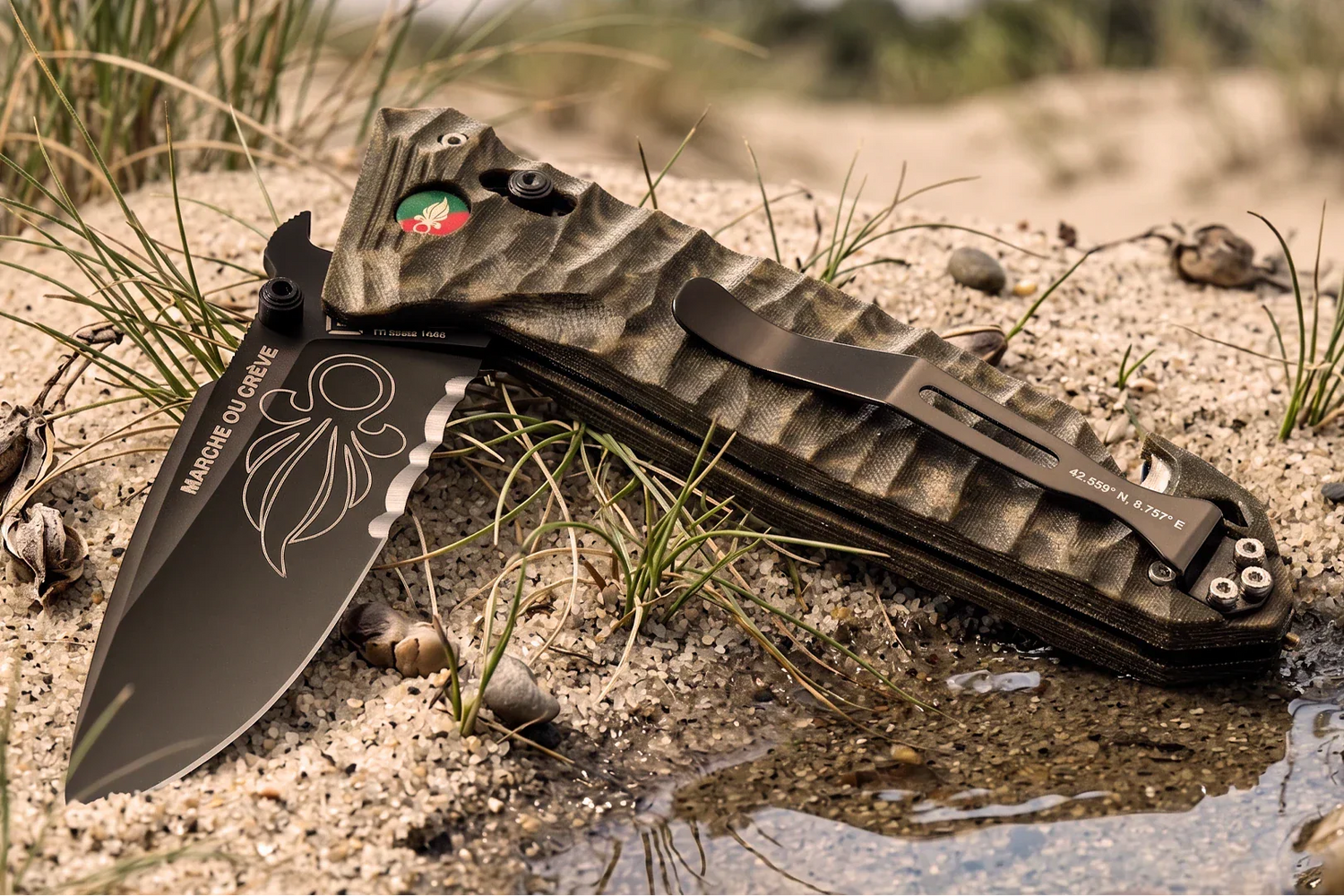
Our general maintenance guide covers the basic steps to keep an outdoor knife in good condition. This protocol goes further: it is for those who use their knife in truly demanding conditions — sand, saline environment, intense cold, intensive use — where a simple wipe is no longer enough to preserve the mechanical reliability of the C.A.C.® over time.
Why a separate protocol from routine cleaning
Routine maintenance deals with the surface: cleaning, drying, oiling. The field protocol deals with what happens inside the mechanism and in the critical areas of the assembly — where sand infiltrates, where salt crystallizes, where screws loosen under vibration. Ignoring this dimension means risking that a knife that seems clean on the surface accumulates mechanical play or invisible internal corrosion until the moment the tool needs to be 100% reliable.
Step 1 — Diagnosis after extreme exposure
Before maintenance, it is necessary to identify the type of stress suffered:
- Saline exposure (sea spray, perspiration, seawater) — prioritize rinsing and neutralizing salt before any other operation.
- Sandy exposure — prioritize partial disassembly to remove particles lodged in the mechanism.
- Intensive cutting use (ropes, straps, wood) — prioritize inspection of the edge and resharpening if necessary.
Step 2 — The correct disassembly order
The C.A.C.® uses two distinct types of screws on its handle, and the disassembly order is not interchangeable. As detailed in our article dedicated to black and stainless steel screws:
- First, unscrew the black screws, without any particular precaution — they release the mechanical tension of the assembly.
- Then, unscrew the stainless steel screws, treated with Teflon, with small jerks (rotation, pause, resumption) — never in continuous rotation, at the risk of premature wear of the coating.
Reversing this order, or treating both types of screws in the same way, is the most common cause of damage during field maintenance intervention.
Step 3 — Mechanism treatment after sand exposure
Once the scales are removed, eliminate particles lodged around the pivot with compressed air or a soft non-metallic brush — never use pressurized water, which pushes sand deeper into the mechanism rather than evacuating it. Then apply a thin drop of oil on the pivot to restore the fluidity of the mechanism.
Step 4 — Salt neutralization before reassembly
After saline exposure, rinse all metal parts with fresh water and then dry completely before reassembly — residual moisture trapped under the scales is the main cause of invisible internal corrosion. A thin layer of clear oil on the metal parts completes the protection before reassembly.
Step 5 — Blade play control
The C.A.C.® mechanism incorporates a play take-up system. After intensive use or extreme exposure, check for any lateral blade play in the open position. Slight play that appears gradually is normal and can be corrected via this system — play that appears suddenly after a shock should be inspected before operational reuse.
Step 6 — Inspection and resharpening
Check the condition of the edge with glancing light to spot micro-chips. Resharpen if necessary to the original angle (17° per side for a standard Nitrox® or MOX® blade) with a folding diamond sharpener.
Step 7 — Reassembly and final verification
Reassemble in the reverse order of disassembly: stainless steel screws first (with small jerks), then black screws. Check one-handed opening and closing, belt clip operation, and the absence of any hard spots on the mechanism.
Recommended frequency
| Usage context | Frequency of full protocol |
|---|---|
| Occasional use, normal conditions | Routine maintenance sufficient, full protocol 1 to 2 times a year |
| Regular outdoor use | Full protocol every 2-3 months |
| Occasional saline or sandy exposure | Full protocol immediately after exposure |
| Intensive operational use | Full protocol after each mission or prolonged outing |
The C.A.C.® maintenance kit
The C.A.C.® maintenance kit (€21) includes oil, adjustment tool and common spare parts are available separately on our website to carry out this protocol without improvising with unsuitable tools.
Frequently asked questions
Should the knife be disassembled after each use?
No. Complete disassembly is reserved for situations of extreme exposure (sand, salt) or periodic maintenance. Routine maintenance (cleaning, drying, light oiling) is sufficient for normal use.
What tool to unscrew the C.A.C.® screws?
A T 1.5 hex key, included in the maintenance kit.