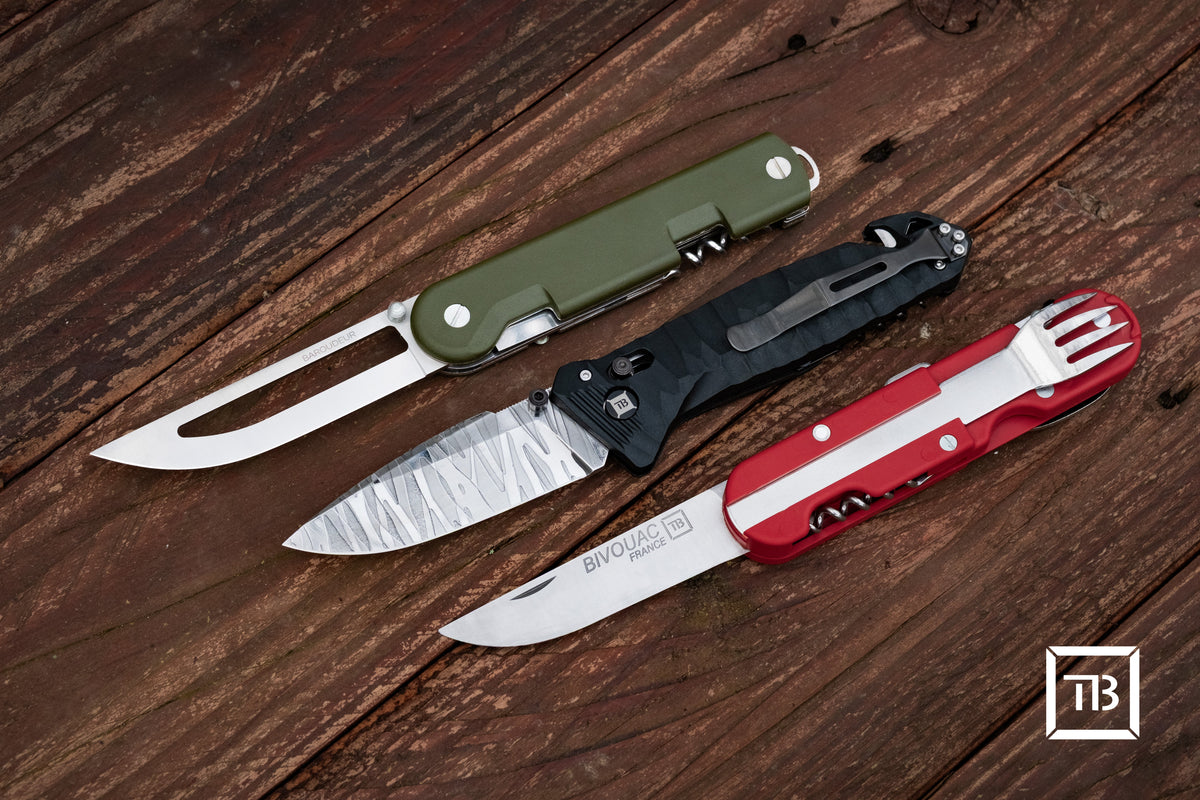
Bivouac®, Baroudeur®, C.A.C.®: three names, three eras, one single common thread — TB-Outdoor has been equipping the French army without interruption since 1996. These three knives are not marketing variations of one another. They are three tools designed at different times, for uses that partially overlap but are not identical. Here is how to distinguish them and which one corresponds to your usage.
Three models, three generations of field feedback
Each model was designed based on feedback (RETEX) from the previous model, not in rupture with it:
- Bivouac® (1996) — the first issue knife provided by TB-Outdoor to the French army. A folding knife designed as a simple, robust, and reliable tool for daily field use. It remains in the catalog and in service until 2001.
- Baroudeur® (2001-2017) — succeeds the Bivouac® as the standard issue reference. Like the Bivouac® and the C.A.C.®, it is a folding knife — the distinction is not based on the blade type, but on the integrated accessories: the Baroudeur® includes an independent spoon and fork (not attached to the handle), designed for camp life and prolonged bivouacking.
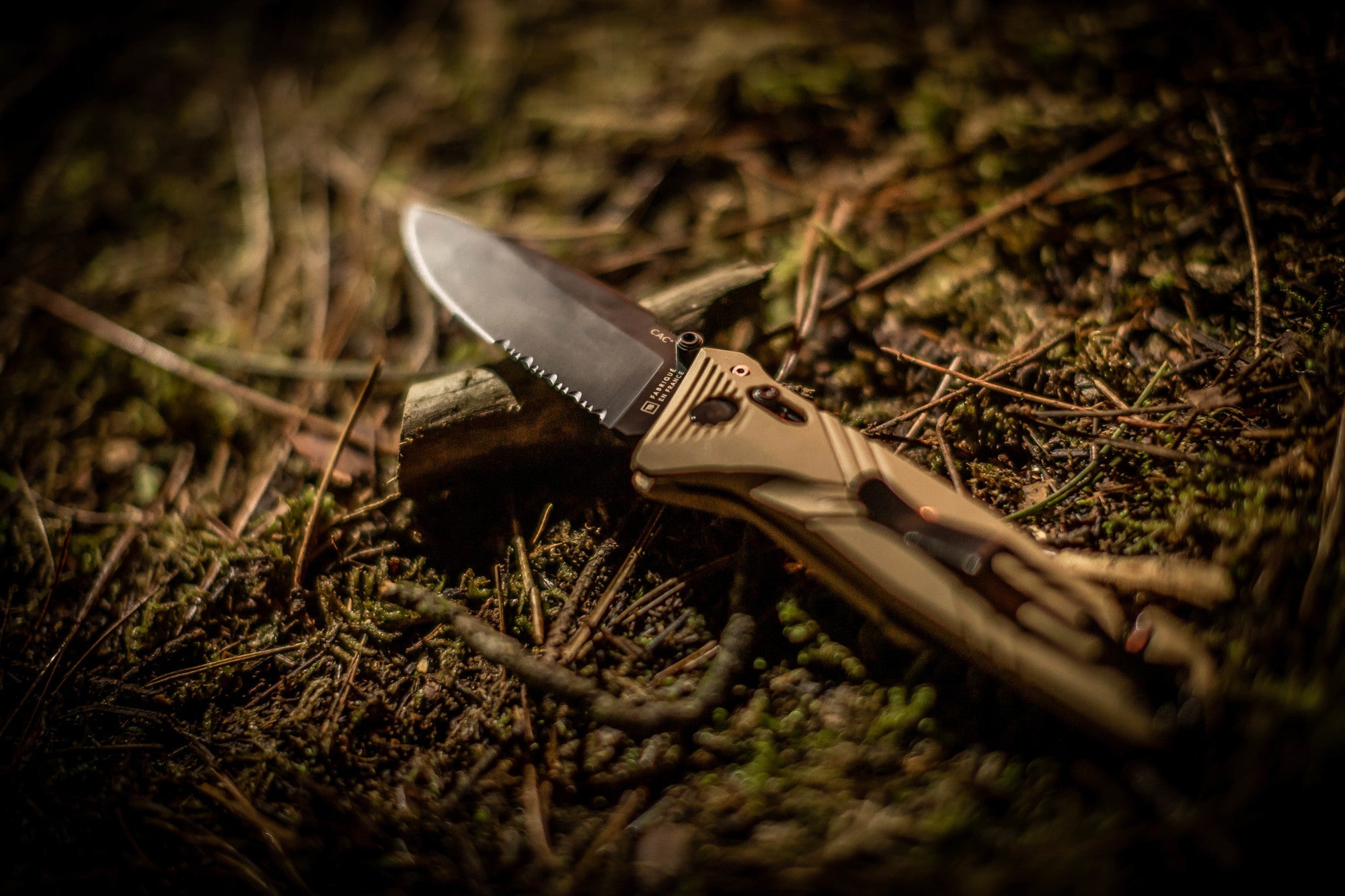
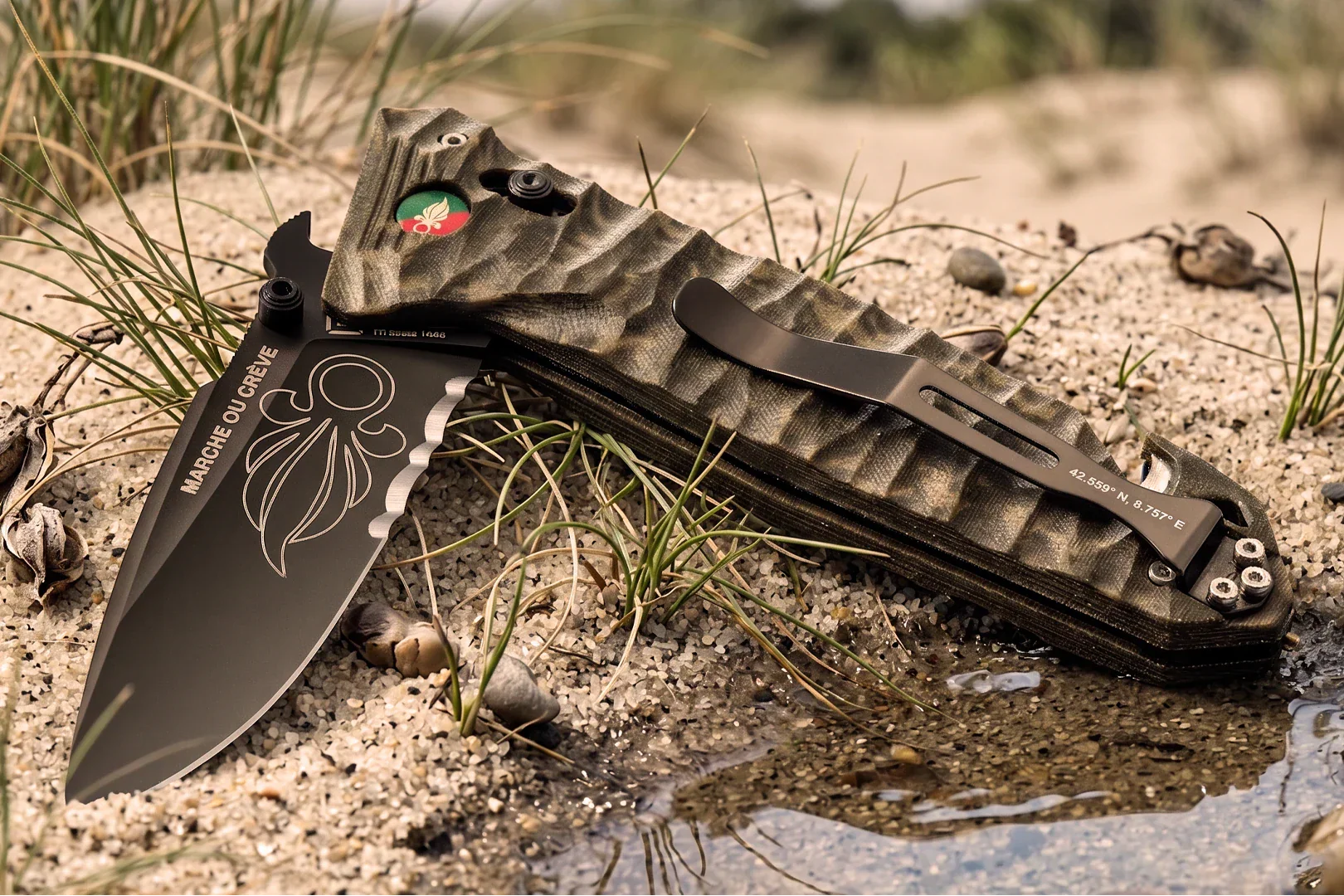
- C.A.C.® — Combat Assistance Campagne (2018) — the current issue model. A modular folding knife that combines features developed and validated over two decades of field feedback: strap cutter, glass breaker, blade play compensation mechanism, interchangeable handle.
All three models remain available for sale today. This is not a case where the old model was withdrawn in favor of the new one: each retains uses for which it remains relevant.
Comparison table
| Criteria | Bivouac® | Baroudeur® | C.A.C.® |
|---|---|---|---|
| Type | Folding knife | Folding knife | Folding knife |
| Year of issue | 1996 | 2001 | 2018 |
| Current status | Still in catalog | Still in catalog | Currently in active service |
| Positioning | Simple tool, daily field use | Camp life, prolonged bivouacking | Modular tactical versatility |
| Integrated features | Standard blade | Independent cutlery (spoon, fork) | Strap cutter, glass breaker, corkscrew (depending on version) |
| Available configurations | Limited range | Limited range | More than 27 configurations |
| Licensed editions | No | No | French Navy MN400, French Foreign Legion |
What really sets the Baroudeur® apart: independent cutlery
The Baroudeur® is not a combat knife like the C.A.C.®, nor a minimalist tool like the Bivouac®. Its uniqueness lies in its accessories: a spoon and a fork, not fixed to the handle but provided as independent pieces, designed for mess kits and camp life during prolonged operations. It is a design choice distinct from a classic multi-tool knife — no utensils articulated on the handle, but separate pieces, easier to clean and replace individually.
The official TB-Outdoor text describes it as a "true survival companion that has sometimes saved lives" — a positioning consistent with prolonged field use, where nutritional autonomy is part of the equipment, just like cutting capability.
Why the C.A.C.® replaced the Bivouac® in active service
The C.A.C.® is not a cosmetic improvement of the Bivouac®. It incorporates two additional decades of field feedback, the collaboration with Philippe Perotti (formerly of the French special forces), and features that the Bivouac® did not have: an interchangeable-blade strap cutter, a tungsten carbide glass breaker, a blade play compensation mechanism, and a reversible belt clip. It is a tool designed for operational versatility rather than the simplicity of the first model.
Which model should you choose according to your usage?
| Profile | Recommended model | Why |
|---|---|---|
| Versatile tactical use, operational EDC | C.A.C.® | Most comprehensive integrated features, multiple configurations |
| Camp life, prolonged bivouacking, cooking | Baroudeur® | Independent cutlery (spoon, fork) integrated into the equipment |
| Intensive bushcraft, batoning | None of the three — see a fixed blade like the Maraudeur® | The three TB-Outdoor issue models are folding knives; batoning requires a fixed blade (full tang) |
| Collector, military history enthusiast | Bivouac® or Baroudeur® | Historical models still in production, reference pieces of the French issue |
| Gift for military or enthusiast | C.A.C.® French Navy or Foreign Legion edition | Symbolic and collectible dimension, same operational technical base |
Frequently asked questions
Are the Bivouac® and Baroudeur® still manufactured today?
Yes. Both models remain in the TB-Outdoor catalog and are produced according to the same standards as the versions provided to the military.
Can a C.A.C.® be used for bushcraft and survival?
Yes, for the majority of common uses. However, for intensive batoning, none of the three issue models (Bivouac®, Baroudeur®, C.A.C.®) are suitable: they are all folding knives, and batoning requires a fixed blade — a folding knife is never recommended for this use.
Is the Baroudeur® a fixed blade?
No. It is a folding knife, like the Bivouac® and the C.A.C.®. Its particularity is to include independent cutlery — a spoon and a fork not fixed to the handle — designed for camp life, not a fixed blade for intensive bushcraft use.
What is the price difference between the three models?
The C.A.C.® offers the widest price range due to its numerous configurations (PA6 FV or G10 handle, licensed editions). Bivouac® and Baroudeur® have more limited configuration ranges.
→ Discover the C.A.C.® | → Discover the Baroudeur® | → Discover the Bivouac®