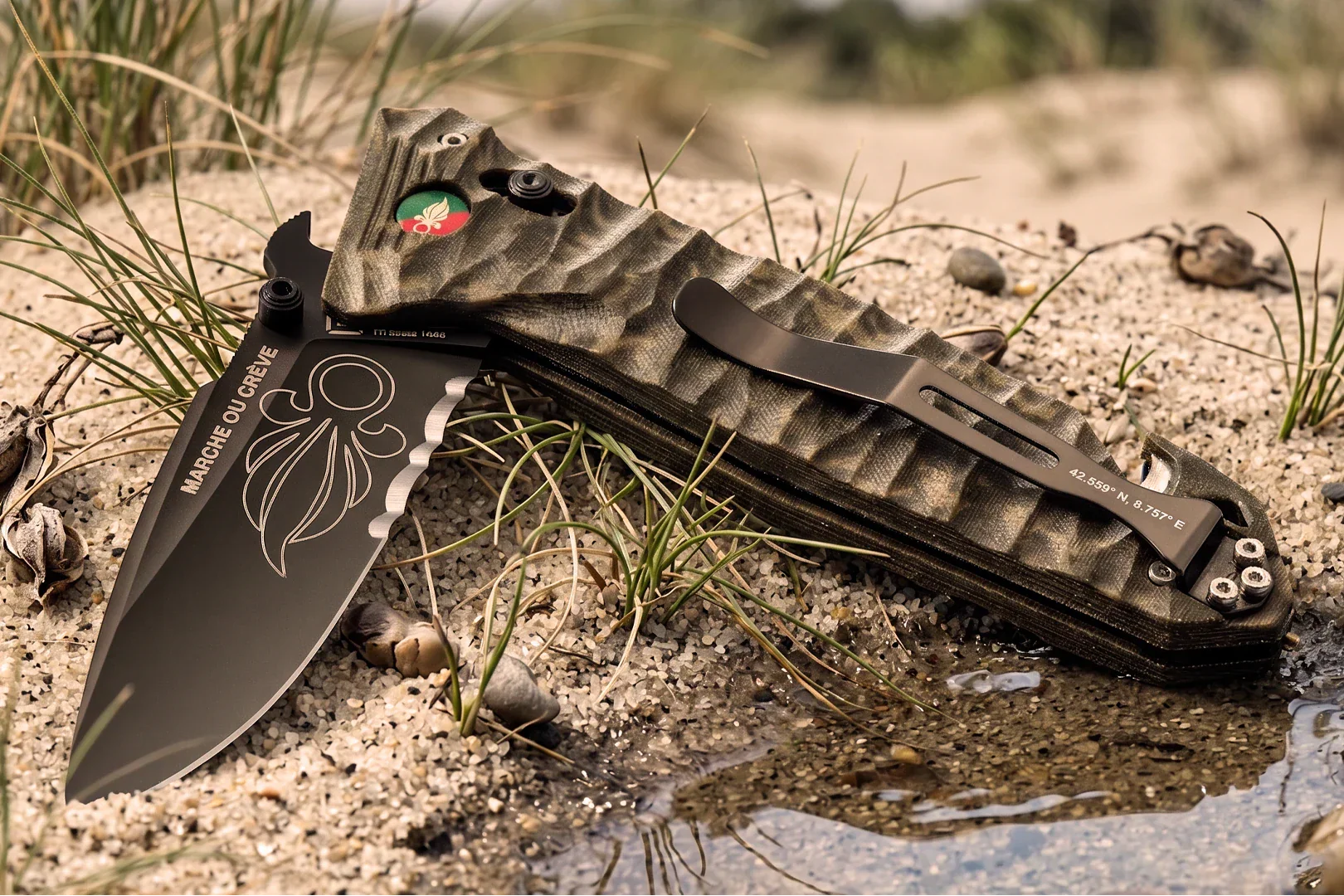

HRC, burr, grind, EDC, batoning... Outdoor and tactical cutlery has its own technical vocabulary, often poorly explained or glossed over. This glossary brings together, in one place, precise definitions of terms you'll come across in our product descriptions, guides, and articles—classified by theme.
Steels and Metallurgy
HRC (Rockwell Hardness C)
A scale for measuring the hardness of steel. The higher the number, the harder the steel—better edge retention, but more technical sharpening and slightly increased fragility to impacts. TB-Outdoor knives are between 55 HRC (Nitrox®) and 58-60 HRC (MOX®).
Nitrox®
Martensitic stainless steel doped with nitrogen, developed for TB-Outdoor knives. Indicative composition: 16% chromium, 0.35% carbon, added nitrogen to reinforce resistance to localized corrosion (pitting). Hardness of 55 HRC, sharpening angle of 17° per side. This is the standard steel for the C.A.C.® range.
MOX®
Alternative stainless steel in the TB-Outdoor range, with higher chromium and carbon content than Nitrox® (chromium >16%, carbon >1%). Superior hardness (58-60 HRC), excellent corrosion resistance, but more technical sharpening. Recommended choice for intensive use where edge retention takes precedence over ease of field maintenance.
Damascus Steel
Layered steel obtained by forging multiple layers of metal, producing a characteristic visual pattern. Sought after for its aesthetics as much as for its performance, which depends on the steels used in the layering.
Heat Treatment
All heating, quenching, and tempering operations that determine the final mechanical properties of steel (hardness, toughness). A decisive manufacturing step, independent of the steel's chemical composition alone.
Geometry and Sharpening
Grind
The operation of beveling (in a "V" shape) the two faces of a blade to give it its cutting geometry. Historically done by hand on a grindstone by the "master grinders" of Thiers, today performed by precision grinding equipment.
Sharpening Angle
The angle formed between the plane of the blade and the plane of the edge, measured per side. A low angle (e.g., 15-17°) provides a finer cut but a more fragile edge. A wider angle (20-25°) provides a stronger edge but a less precise cut. The C.A.C.® is sharpened at 17° per side at the factory.
Burr
A thin metallic burr that forms on the edge during sharpening. Its disappearance (or complete detachment during the final sharpening pass) is an indicator that the edge is properly formed.
Plain Edge / Partially Serrated Edge
A plain edge offers a clean cut on all types of materials and sharpens in a single, smooth pass. A partially serrated edge combines a plain section and a serrated section, useful for sawing fibrous materials (ropes, straps) even when the plain part is dull.
Usage Techniques
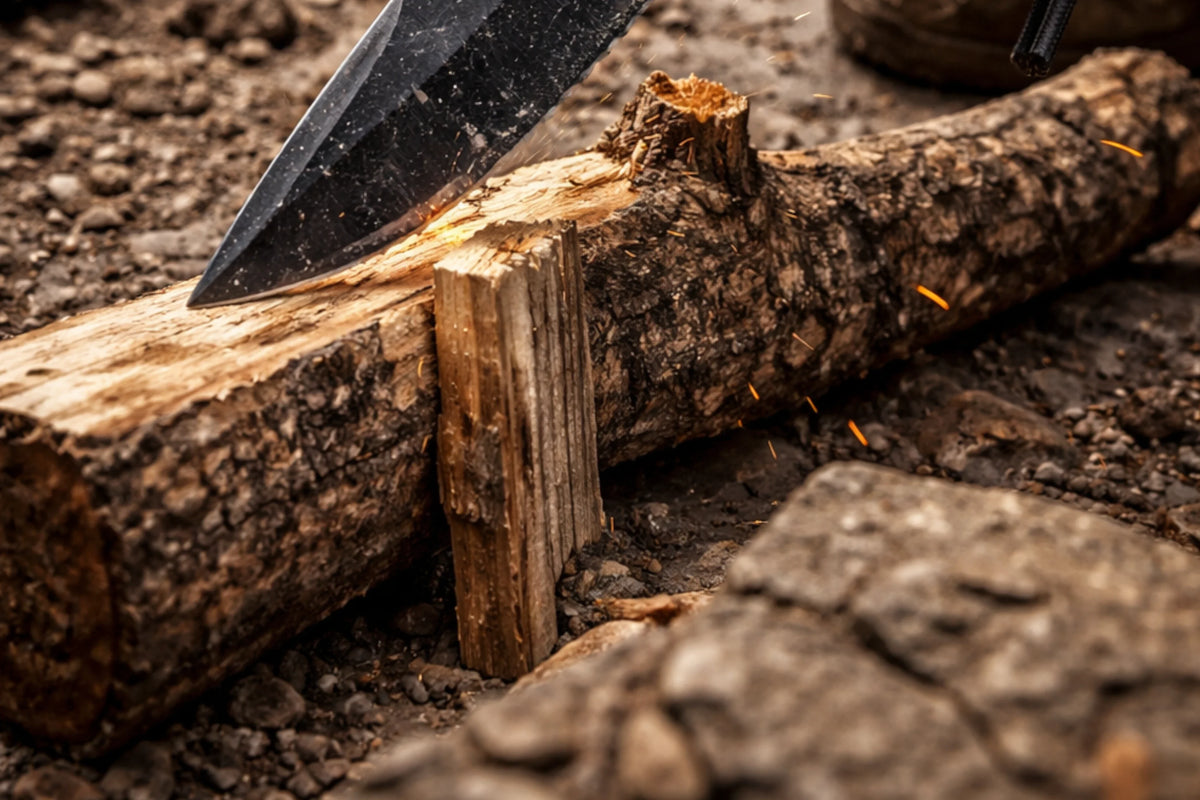
Batoning
A technique of splitting wood by striking the spine of a fixed blade with a stick, to produce kindling without an axe. Reserved for fixed blades—never for folding knives, which pose a risk of accidental closure under this stress.
EDC (Every Day Carry)
A category of gear—including knives—designed to be carried daily. An EDC knife prioritizes compactness and discretion compared to a tool dedicated to specific intensive or operational use.
Handles and Materials
PA6 FV (Glass Fiber Reinforced Polyamide)
Standard handle material for the C.A.C.®. A technical polymer reinforced with short glass fibers, offering good resistance to impacts and deformation, with a slight "flex" that absorbs sudden impacts.
G10
Glass fiber / epoxy resin composite, machined individually from solid blocks. Superior dimensional stability to PA6, better chemical resistance, heavier and more expensive to produce.
Functions and Accessories
Strap Cutter
An integrated, often interchangeable, secondary blade designed to quickly cut a strap or seatbelt in an emergency.
Glass Breaker
A tungsten carbide tip integrated into the knife, designed to break a vehicle window for emergency extraction.
Safety Axis
An accessory that allows the blade of a folding knife to be locked in the open position, temporarily transforming it into a fixed blade for certain specific uses.
Labels and Recognitions
EPV — Entreprise du Patrimoine Vivant (Living Heritage Company)
A label awarded by the French State to companies whose excellence in artisanal or industrial know-how is recognized. Obtained by GDD, industrial subsidiary of Tarrerias Bonjean, in 2001.
Hénokiens
An international association founded in 1981, bringing together family businesses at least 200 years old, still managed by descendants of the founder. The Tarrerias Bonjean Group, parent company of TB-Outdoor, is a member.
Frequently Asked Questions
What's the difference between Nitrox® and MOX® in one sentence?
Nitrox® prioritizes ease of field sharpening, MOX® prioritizes long-term edge retention.
Can batoning be performed with any knife?
No, only with a suitable fixed blade—never with a folder.