For the bushcrafter, the fixed-blade knife is more than just a cutting tool: it's an extension of the hand, a truly multifunctional tool essential for survival and comfort in the wilderness. However, its full effectiveness is only realized through the mastery of specific techniques, often unknown to novices. Beyond cutting rope or preparing food, your knife can become a plane for roughing out wood or an ultra-reliable fire starter. This article reveals five fundamental techniques that will transform the way you use your knife, increasing your self-reliance and safety during your expeditions. These methods require a robust, high-quality knife capable of withstanding impacts.
Key points: the knife, an essential tool
| Technical | Objective | Knife required |
|---|---|---|
| Batoning | Split the wood to access the dry heartwood. | Fixed blade (Full Tang) and robust. |
| Blade spine at 90° | Lighting the fire and precise scraping. | Blade with a non-rounded dorsal edge. |
| Feathersticks | Prepare the tinder for quick ignition. | Very sharp and stable blade. |
| Flat knife | Roughly scrape or remove the bark. | Fixed blade of at least 10 cm. |
Which knife should I choose for demanding work in the forest?
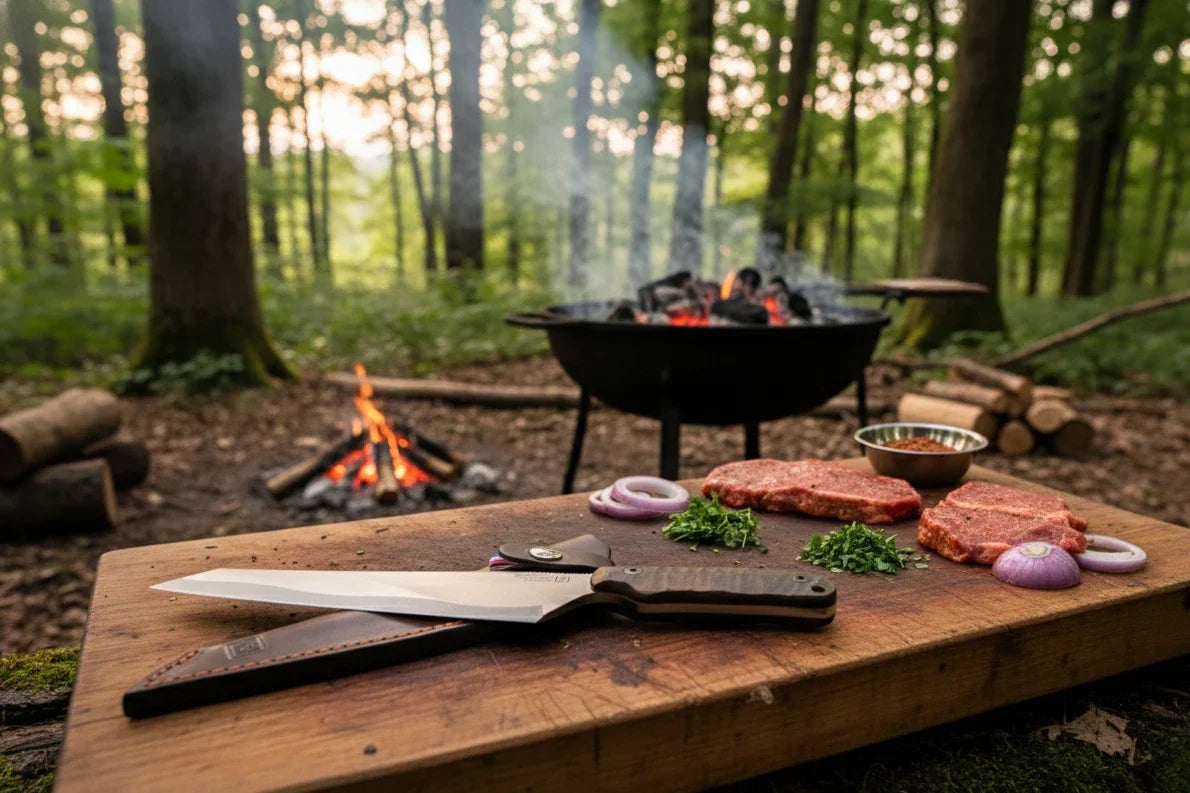
The first step to mastering these techniques is having the right tool. Using a knife like the **Maraudeur®** from TB Outdoor, with its Full Tang construction (blade and handle are one), is the best guarantee of **reliability** and **safety** for heavy-duty work. Folding knives, while versatile for light tasks, cannot withstand the pressure of intensive batoning and are prone to damage.
Your knife should be considered an essential tool for your survival.
Technique 1: How to transform your knife into a woodworking tool (plane)?
For rough work, such as quickly removing a large amount of bark or shaping a piece of wood for a trap or tool, you can temporarily turn your knife into a plane.
- Select a sturdy branch approximately 5 cm in diameter and 15 cm in length.
- Push the tip of your knife blade into this branch to create a second handle.
- You are now holding the tool by both ends: the original handle and the makeshift branch.
- Work the wood by pulling the blade towards you (carefully), which gives increased **power and control**, far superior to simple one-handed cutting.
This technique requires a knife with a blade that is thick enough not to bend or break at the tip.
Technique 2: Why use the back of the blade at 90 degrees?
The back edge of the blade is often overlooked, but it is vital. A blade back that is not rounded, with a 90-degree angle (often called a "sharp spine"), offers two crucial possibilities for survival:
Lighting the fire
This is the most common use. A 90-degree blade back is the ideal scraper for your firesteel. It allows you to scrape the ferrocerium with force and precision, creating a shower of high-temperature sparks directly onto your tinder. The blade's edge remains intact.
The working of materials
The back of the blade allows you to scrape and rake without cutting. This is useful for:
- Scrape the outer, rough bark of a root to retain the fibrous heart for the manufacture of **natural rope**.
- Prepare a surface by removing the soft or dirty layer.
Make sure the back edge of your knife is sharpened to a 90-degree angle for this effectiveness.
Technique 3: Why is stirring vital in a humid environment?
Batoning is the technique of using a heavy stick (the "baton") to strike the back of a knife blade, forcing it to pass lengthwise through a piece of wood. It is an alternative to using an axe or a sledgehammer.
- Access to dry wood: This is the most reliable method for accessing **wood that is dry throughout**, even after several days of rain. The exterior wood is damp, but the interior wood is not.
- Wood splitting: It allows you to split logs larger than what the hand alone could cut, transforming large pieces of wood into ideal fuel for fire.
Crucial warning: This technique puts severe stress on the knife's structure. It is **only for full-tang fixed-blade knives** (where the blade extends the full length of the handle). Using a folding knife or multi-tool for batoning is the surest way to break it.
[Image showing a fixed tactical or bushcraft type knife being used for batoning]
Legend: Batoning is a forceful technique that requires a Full Tang knife to ensure safety and durability.
Techniques 4 and 5: Creating fire and working wood with precision
Technique 4: How does the making of feathersticks accelerate the ignition of the fire?
The feather stick is a cornerstone of fire preparation. It involves cutting very thin loops of wood from a branch, without completely detaching them. These thin loops have two major advantages:
- They create a **large contact area** with the flame or spark.
- They **aerate** the wood, making it easier to grip.
The secret is to use a knife with an **impeccable edge** and apply even, light pressure. These ultra-thin shavings ignite almost as quickly as tinder, acting as a bridge between the spark and the larger piece of wood.
Technique 5: What grip should be adopted for fine and precise work?
For precision work (making a fine point, carving a small piece), holding the knife in your hand can be tiring and less precise. The "locked grip" technique offers more control:
- Wedge the knife handle (or the middle of the blade if it is fixed) at knee or thigh level (leg bent at 90 degrees).
- Hold the piece of wood firmly with both hands.
- Bring the wood towards the edge of the knife, allowing a cut by sliding the wood rather than by moving the knife.
This method allows the **body weight** to be used for cutting and reduces the risk of accidents, as the knife remains fixed and stable.
Equip yourself with a TB Outdoor knife designed for these demanding techniques.
Frequently Asked Questions (FAQ)
Can I use a folding knife for batoning?
No, it is strongly discouraged. Folding knives have a locking mechanism (the weak point) that is not designed to withstand the lateral pressure and impacts of batoning. Such use risks damaging, or even breaking, the mechanism and the blade, potentially resulting in serious injury.
What is the purpose of Full Tang?
A full tang knife means that the blade extends continuously along the entire length of the handle. This guarantees maximum resistance to twisting and impacts, essential for heavy-duty tasks such as batoning or using it as a lever.
Does a survival knife need to be large?
Not necessarily. While longer blades are better for batoning, a 10-15 cm blade offers the best compromise between versatility, maneuverability for fine work (feathersticks), and power. The important thing is the quality of the steel and the full tang construction.
Glossary of knife techniques
- Batoning: A technique that uses a stick to strike the back of the blade and split the wood lengthwise.
- 90° blade spine: Non-rounded and sharp dorsal edge of the knife, used for scraping firesteel or wood without damaging the main cutting edge.
- Featherstick: A stick prepared with very fine wood shavings attached to serve as an effective fire starter.
- Full Tang: Refers to a blade that goes all the way through the handle, guaranteeing maximum robustness.
- Plane: A two-handled woodworking tool. In bushcraft, the knife can be adapted for similar use.