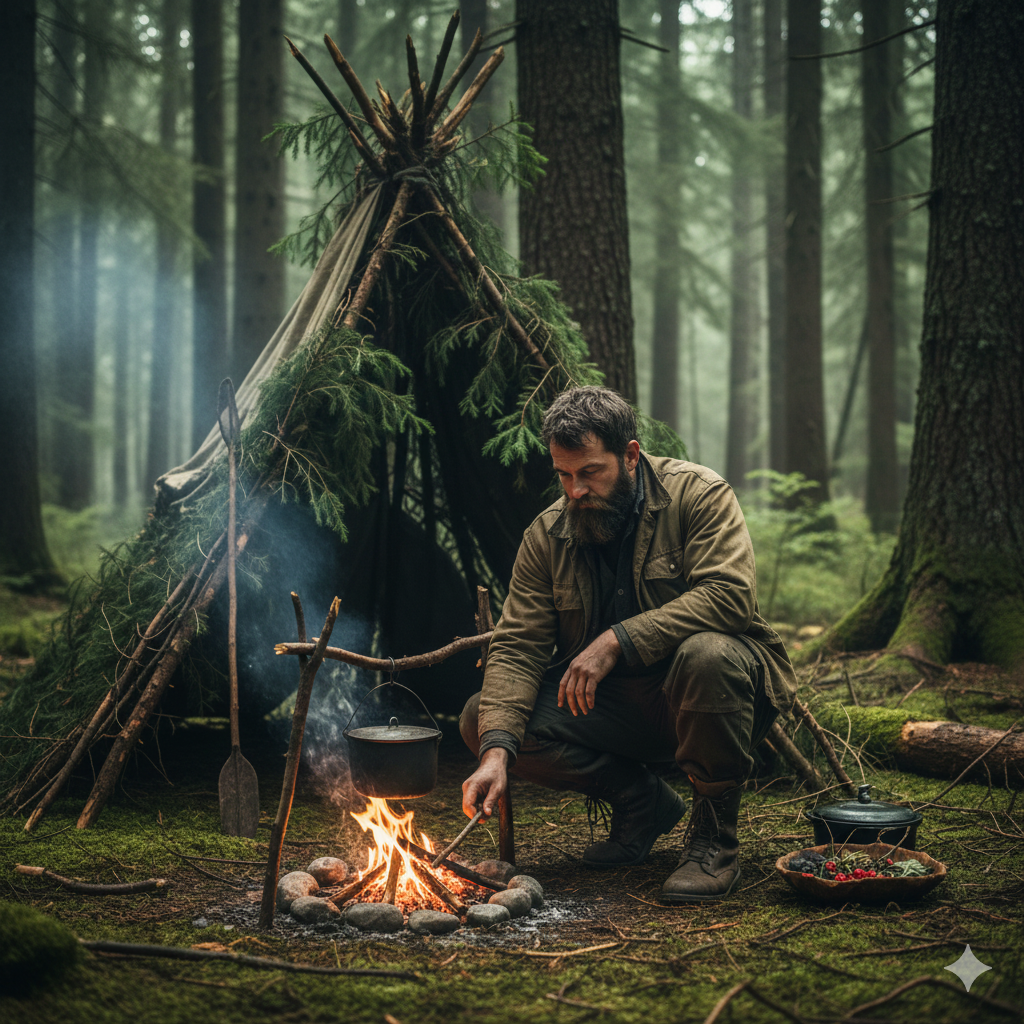

After fire, shelter is the second essential pillar of bushcraft and survival. In the forest, your shelter is your **living space** and your **first line of defense** against the harshness of nature, especially in winter. Its role is twofold: to guarantee your safety and to ensure a minimum level of comfort for restful sleep. Building a shelter is not simply a matter of piling up a few branches. It requires careful consideration of the site, the materials, but above all, insulation and weatherproofing. Here, we will explore the fundamental criteria for creating a robust campsite, adapted to changing weather conditions, and tips for staying dry and warm, even in extreme cold.
A well-designed shelter can save your life by preventing hypothermia. It's an investment of time that pays off immediately in peace of mind and energy for the next day.
Key points for a successful shelter
| Criteria | Main Objective | Insulation Advice |
|---|---|---|
| Security | Coping with changing weather conditions. | Choose a stable site, sheltered from wind and floods. |
| Insulation | Maintain a stable body temperature. | Create a layer on the ground (mattress of leaves or branches). |
| Waterproofing | Stay dry. | Multi-layer cover (leaves, bark, or tarp fabric). |
| Aeration | Avoid condensation. | Ensure a minimum airflow at the top. |
What is the essential role of your campsite shelter?
In bushcraft, a shelter is not simply a place to sleep. It is a crucial element of your physical and mental "survival kit." Its primary function is **thermal preservation**: minimizing the loss of body heat (convection, conduction, radiation, evaporation). The more effective the shelter, the less energy your body needs to expend to stay warm.
A good shelter also guarantees:
- Protection: Against rain, snow, wind, and potentially against insects or small animals.
- Rest: It should allow you to rest and sleep peacefully, an essential condition for staying alert and making good decisions the next day.
- Safety: In case of rapid changes in weather conditions (storm, drop in temperatures), it offers you immediate shelter.
Neglecting shelter risks exhaustion, lack of sleep and, in the worst cases, hypothermia.
What are the fundamental criteria for effective construction?
For a shelter to be truly effective, two criteria must be met, often perceived as contradictory, but which must be balanced: airtightness and ventilation.
How to ensure waterproofing and protection against moisture?
Water is the number one enemy in cold environments. Wet clothing or sleeping bags lose all their insulating properties. Waterproofing must be ensured on two levels:
- The roof: It must have a sufficient slope to allow water to drain quickly. Use dense layers of natural materials (pine leaves, bark, mulch) or, if you have one, a military-grade tarp.
- The ground: This is often where moisture rises. Never sleep directly on the ground. Create a raised platform or an **insulation mattress** at least 15 to 20 cm thick using dry leaves and small branches.
Why is ventilation crucial?
In winter, the warm, humid air you exhale condenses on the cold walls of the shelter. This condensation wets your clothes and equipment, negating the insulation. To counteract this:
- The shelter must be **well insulated** so that the inner wall remains as warm as possible.
- Leave a **small opening** or vent at the top of the shelter (the highest point) to allow stale, humid air to escape. This is the delicate balance between airtightness and ventilation.
How to adapt the size of your shelter?
A common mistake beginners make is building a shelter that's too big. An oversized shelter is difficult to heat and insulate because the empty space absorbs your body heat.
- For an individual shelter: It should be just large enough for you to lie down and turn around in, with a little space for your essential equipment. Aim for a minimalist interior space.
- For a group: A communal shelter is more effective, as the body heat of several people helps to warm the space. The construction should therefore be proportional to the number of occupants, while ensuring that the same insulation requirements are maintained.
[Image of a debris hut-type shelter, showing a significant thickness of insulation on the roof]
Legend: A well-insulated shelter is small and compact to maximize the retention of heat given off by the body.
How important is the sleep system in isolation?
Even the best shelter isn't enough if your sleeping equipment is inadequate. The majority of heat loss occurs through **conduction** with the ground and **radiation** into the open air.
Insulation layer on the ground and sleeping bag
The ground acts as a heat sink. Insulation is essential.
- Use a sleeping mat or the famous thick layer of natural materials (leaves, pine needles).
- A sleeping bag suited to the temperature is the simplest and most modern solution. Make sure it's clean and dry to maintain its loft and insulating properties.
The military cover alternative
Some purists prefer versatile solutions, such as a **military-style wool blanket** (often thick, robust, and retaining its properties even when wet). Wool can be used alone in a well-insulated shelter, or as an additional layer of warmth under a sleeping bag.
Warmth tip: To optimize your night's sleep, don't hesitate to put on some extra dry wool socks before getting into your sleeping bag. If your extremities (feet, hands, head) are cold, your whole body will be.
Remember to also bring a **sleeping bag cover (bivy bag)**. It's a waterproof and breathable cover that protects your bag from moisture and adds significant warmth. Discover our sleeping solutions and tactical blankets.
Frequently Asked Questions (FAQ)
Where should you never build your shelter?
Always avoid valley bottoms (cold air accumulates there), riverbanks (risk of flooding or excessive humidity) and under dead trees or threatening branches (risk of falling, called "widows").
What is the ideal thickness of floor insulation?
For floor insulation using natural materials (leaves, needles), aim for a compressed thickness of at least 15 centimeters. The thicker, the better. This is your most critical insulation.
What is a tarp and is it sufficient for shelter?
A tarp is a versatile and lightweight groundsheet. It's perfectly adequate for roof waterproofing and can be pitched in multiple ways. However, a tarp alone provides no side or ground insulation, which must be provided by natural materials or your sleeping gear.
Glossary of survival shelter terms
- Bivy Bag (Bivouac Bag): Waterproof and breathable outer cover used to protect a sleeping bag from moisture and increase insulation.
- Conduction: Heat transfer through direct contact (such as a body touching a cold floor). Floor insulation counteracts conduction.
- Loft: Refers to the loft of a sleeping bag. It's the thickness of trapped air that provides insulation. A wet or compressed bag loses its loft.
- Tarp: English term referring to a tarpaulin or waterproof fabric, essential for quickly creating a watertight roof for a shelter.