The dilemma between a fixed blade knife and a folding model is at the heart of every adventure preparation. At TB-Outdoor, we design tools that meet the realities of the field, whether it's the absolute robustness of the Vengeur® or the compact ingenuity of the C.A.C®. Choosing between these two architectures is not just about aesthetic preference, but about analyzing the mechanical load and portability required for your missions. This technical guide will help you identify the tool that will become a natural extension of your hand, forged with Thiers expertise.
- Stability: The fixed blade knife eliminates any risk of locking mechanism failure.
- Compactness: The folder discreetly integrates into your everyday carry (EDC).
- Maintenance: A fixed blade cleans instantly, ideal for game processing.
- Security: Modern locking systems like the Axis lock offer exceptional reliability.
What is the real difference between the two?
Beyond simple articulation, the difference between a fixed blade and a folder lies in the transmission of energy from the hand to the blade. A TB-Outdoor knife is designed to optimize this dynamic according to the use case.
Construction
A fixed blade knife generally relies on a full tang construction, where the steel is continuous from tip to pommel. Conversely, a folding knife is a complex mechanical assembly comprising liners, a pivot axis, and a locking system. This structural difference directly impacts the tool's ability to withstand torsional forces or repeated vertical shocks.
Strength
In terms of pure strength, the fixed blade knife always wins. The absence of moving parts means there is no potential breaking point under extreme load. However, the modern engineering of our folding models, using materials like PA6 Loaded GF for the C.A.C® handle, offers tensile and impact resistance that far exceeds market standards.
Portability
This is where the folder shines. Its ability to halve its length makes it easy to carry in a pocket or in a survival kit. The fixed blade requires a sheath, often MOLLE compatible as for the Vengeur®, which implies carrying it on a belt or backpack, which is bulkier but makes the tool immediately accessible.
Why choose a fixed blade knife?
The fixed blade knife is the ultimate resilience tool. For TB-Outdoor, it represents the pinnacle of reliability for degraded conditions.
Robustness
With a model like the Maraudeur, you have a Mox steel blade with a hardness of 58 HRC, capable of withstanding moderate prying tasks. The rigidity of a fixed blade allows for forceful cuts without fear of the blade closing on your fingers, an important psychological factor in situations of extreme fatigue.
Simplicity
Simplicity is a form of security. A fixed blade does not need an opening mechanism; it is ready as soon as it leaves its sheath. Furthermore, the absence of internal cavities prevents the accumulation of dirt, blood, or resin, simplifying field maintenance.
Intensive outdoor use
For batoning (splitting wood by striking the spine of the blade) or processing large game, the fixed blade is indispensable. Its often thicker blade geometry, like the Vengeur®'s 138 mm blade, provides inertia and stability that folders cannot match without becoming too massive.
Why choose a folding knife?
The folder is the tool of agility. It responds to a philosophy where the tool must be present without being burdensome.
Compactness
A Bivouac weighs only 150 g for a handle length of 140 mm. Once folded, it disappears into a pocket, making itself available for all impromptu tasks of the day without attracting attention.
Everyday Carry
In urban environments or during hikes on frequented trails, the folder is better perceived socially. Its transport is facilitated by belt clips, as on the C.A.C®, allowing for secure and discreet carrying.
Light versatility
TB-Outdoor folders often integrate essential secondary functions. The Bivouac and C.A.C® are equipped with corkscrews, transforming the survival knife into a true conviviality tool during meal breaks.
Which knife to choose according to your use?
Each outdoor activity imposes specific constraints on your equipment.
Hiking
Weight is your priority. A folder like the Bivouac is ideal for preparing a meal or whittling a stick. Its 90 mm stainless steel blade ensures a clean cut without tedious maintenance.
Bushcraft
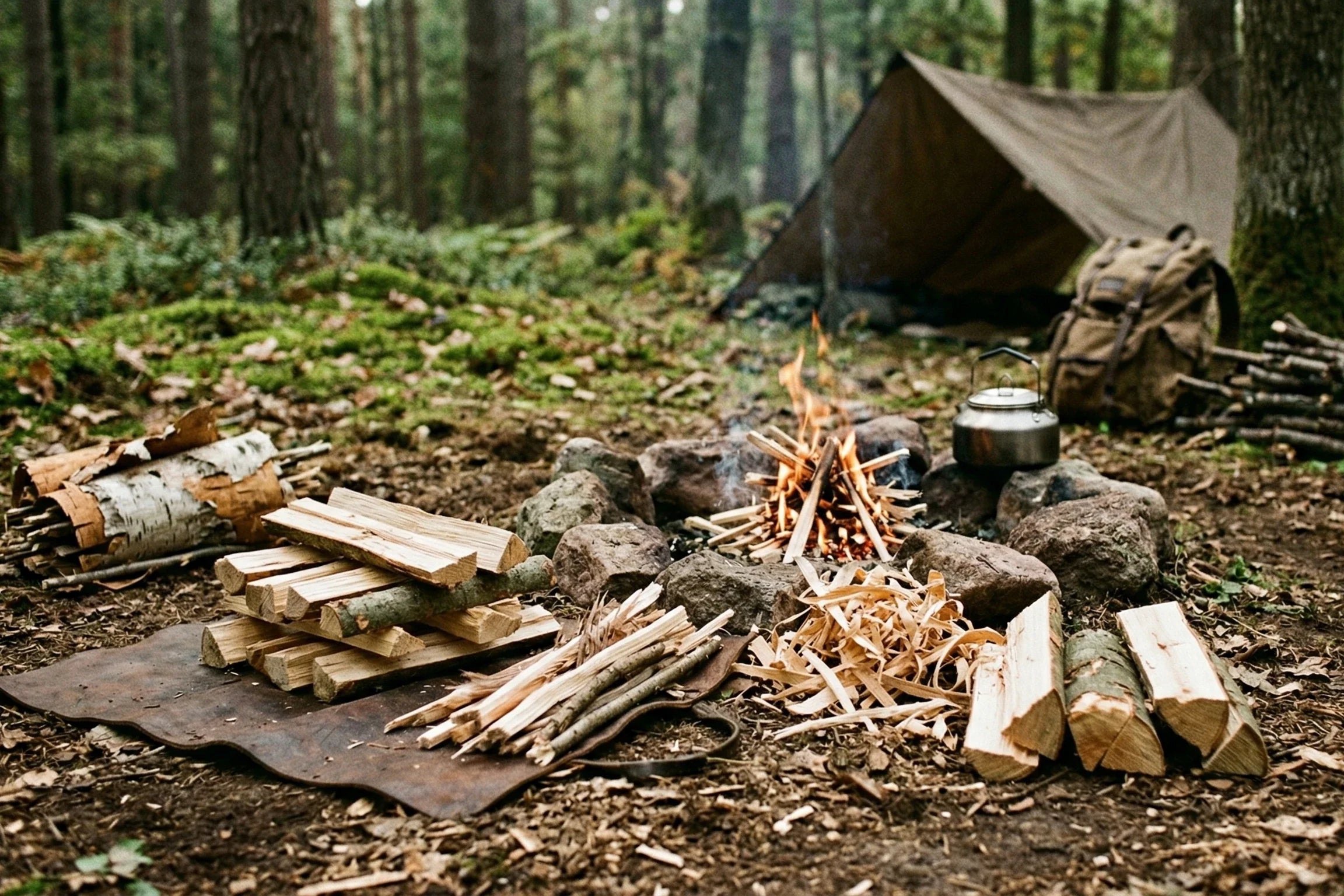
The fixed blade is king. For building a shelter or splitting wood, the structure of the Maraudeur or Vengeur® is necessary. Their sharpening angle of 16° to 17° per side guarantees effective penetration into wood fibers.
EDC (Every Day Carry)
The C.A.C® (Combat Adjutant Cutlery) is the benchmark. Developed for the French army, it combines an ambidextrous opening system with a highly corrosion-resistant Nitrox® steel blade.
Survival
For a survival kit, we recommend the Vengeur® + MOLLE. Its serrated blade allows cutting fibrous materials (ropes, straps) with formidable efficiency, even when the plain edge begins to dull.
Advantages and disadvantages in a table
Here is a comparative summary to help you decide between our different TB-Outdoor ranges.
| Criterion | Fixed Blade Knife (e.g., Maraudeur) | Folding Knife (e.g., C.A.C®) |
|---|---|---|
| Strength | Maximum (full tang) | High (moving axis) |
| Average Weight | 178 g - 200 g | 150 g - 195 g |
| Security | Static (sheath required) | Mechanical lock (Axis/Pump) |
| Maintenance | Very simple (exposed blade) | Moderate (mechanism cleaning) |
| Model | Steel | HRC Hardness | Sharpening Angle |
|---|---|---|---|
| Vengeur® | Mox | 58 | 16° |
| Maraudeur | Mox | 58 | 17° |
| C.A.C® | Nitrox | 55 | 17° |
| Bivouac | Stainless Steel | 51 | 12.5° |
Common mistakes when choosing
Don't fall into classic beginner traps. A survival knife is not a toy; it's a vital piece of equipment.
- Overestimating needs: Buying a massive fixed blade for light hiking is a mistake that results in unnecessary fatigue.
- Underestimating folding knife security: Using a folder without a robust lock for heavy-duty tasks can lead to serious injuries.
- Neglecting the steel: Steel that is too hard is difficult to sharpen in the field. Our Mox and Nitrox® steels offer an ideal compromise.
- Forgetting ergonomics: A handle with a "Chevron" or "Toxified" pattern ensures grip even with gloves; do not overlook this finish.
Our recommendations based on your profile
At TB-Outdoor, we believe there is no bad knife, only tools unsuited for the use.
- For professionals: The Maraudeur is the choice for rigor. Its fixed Mox steel blade and G10 handle guarantee thermal and mechanical stability.
- For versatile adventurers: The C.A.C® is unbeatable. Its integrated strap cutter and ambidextrous opening system make it an ally in all emergency situations.
- For campers: The Bivouac remains the benchmark. Simple, lightweight, and equipped with a corkscrew, it's the companion for every successful bivouac.
FAQ: All about fixed and folding knives
What is the difference in strength between a C.A.C® and a Maraudeur?
The Maraudeur is a full tang fixed blade knife, offering maximum structural resistance for prying. The C.A.C® is a folder whose Axis lock mechanism is extremely robust, but it remains an articulated part.
Can you baton with a TB-Outdoor folding knife?
It is strongly discouraged. Repeated shock to the spine of a folding blade damages the pivot and locking system. For batoning, always use a fixed blade like the Vengeur®.
Why is Nitrox steel used on the C.A.C®?
Nitrox® steel is selected for its very high corrosion resistance and ease of resharpening, essential qualities for a versatile folding knife.