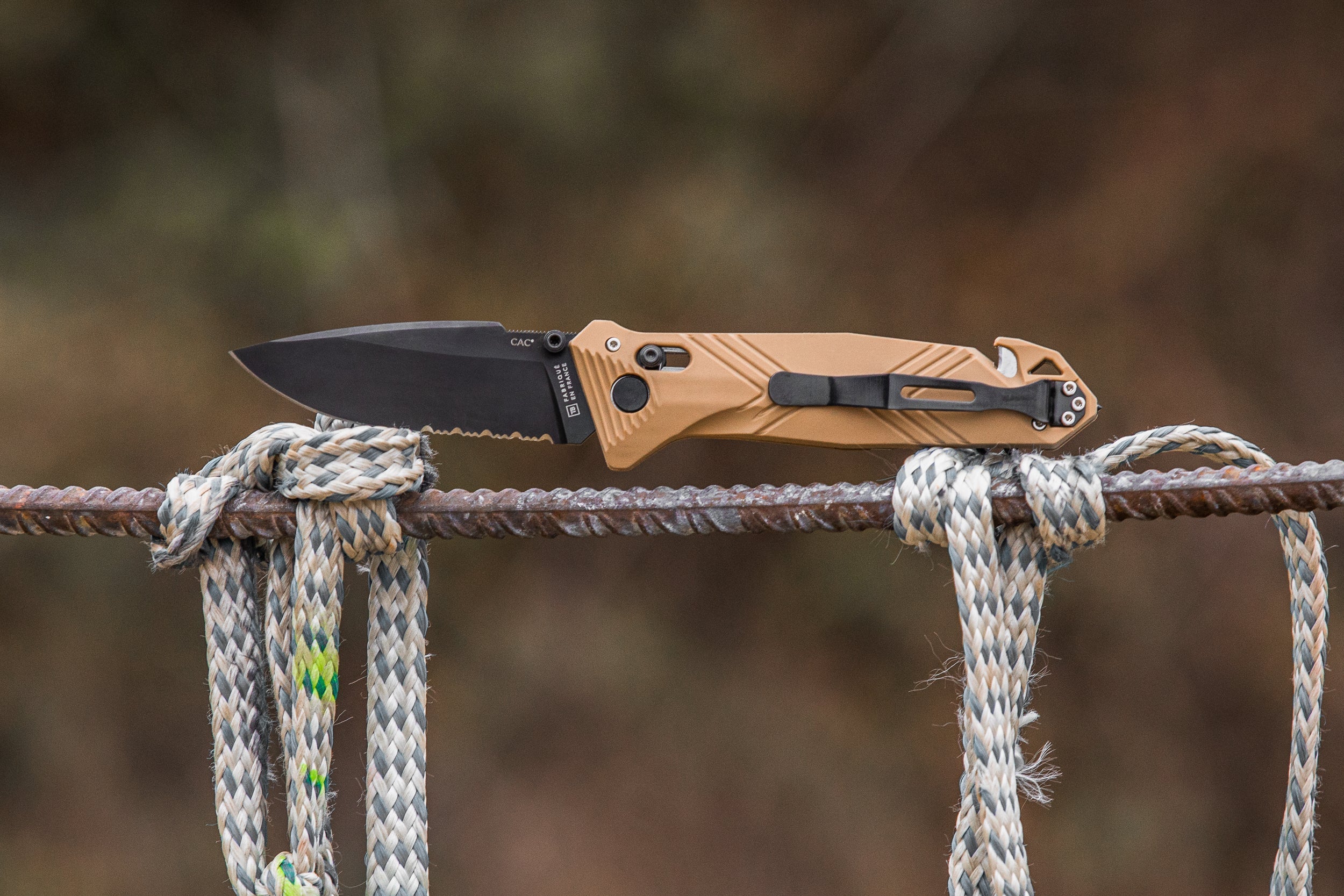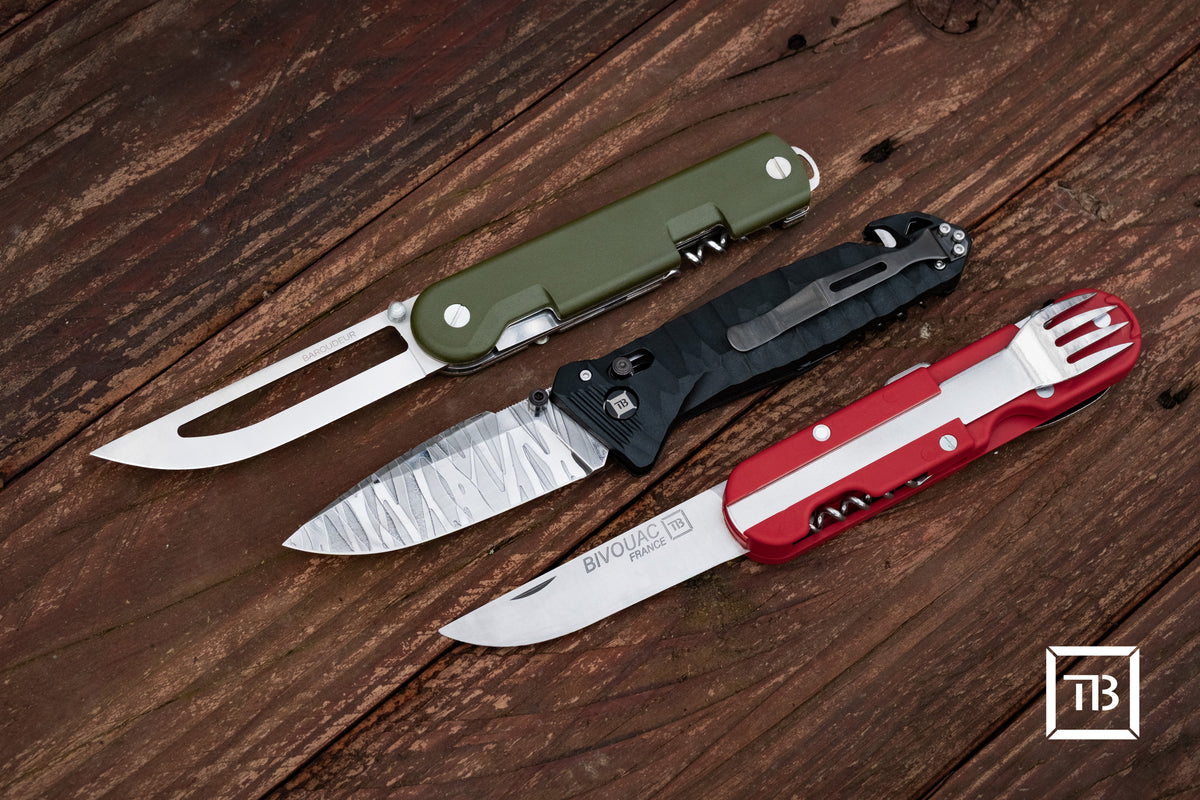
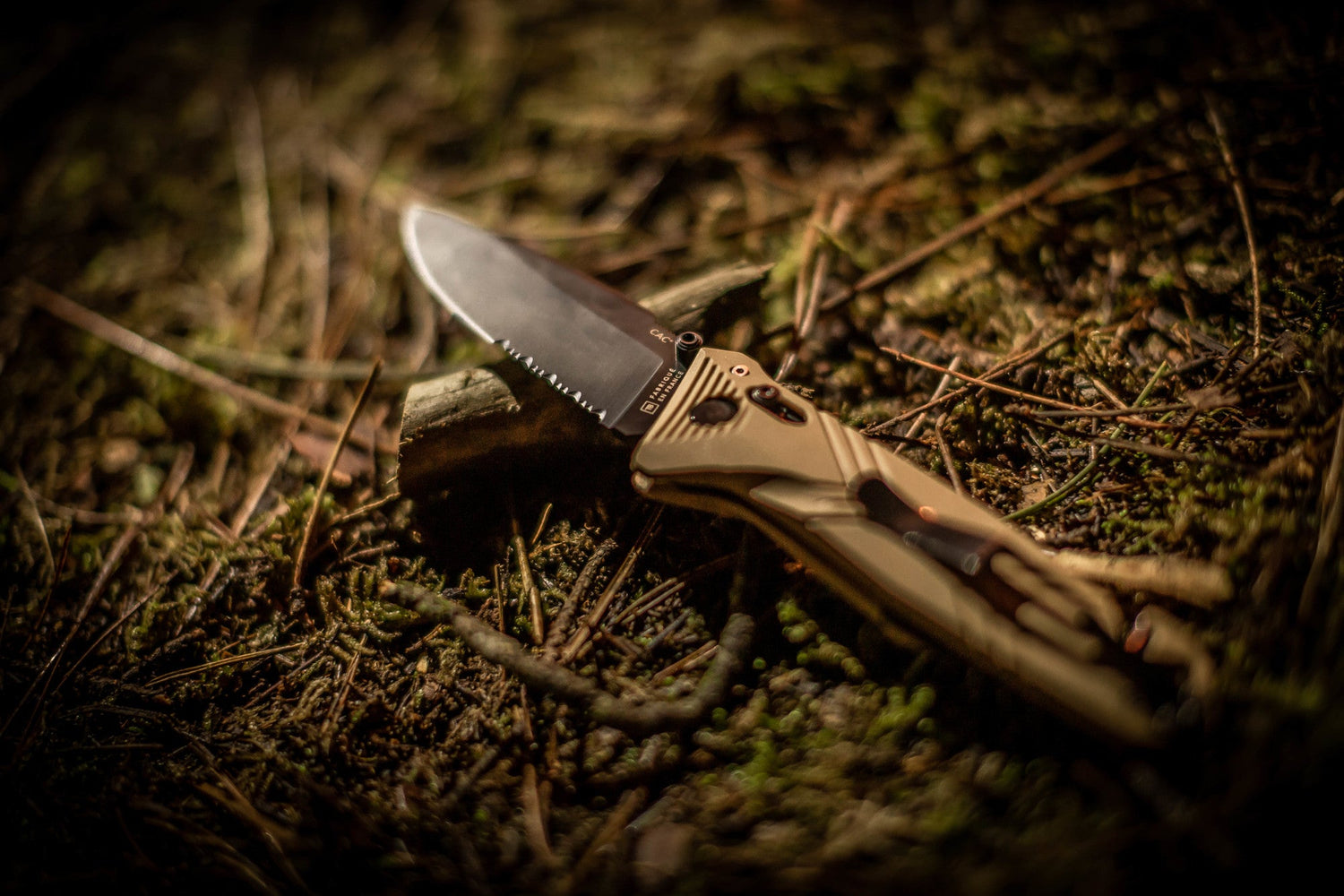
The C.A.C.® — Combat Assistance Campagne from TB-Outdoor is available in over 27 different configurations. Handle colors, materials, blade types, finishes, accessory options, special military editions: the choice can seem complex for a first-time buyer. This guide structures the essential decisions to identify the model best suited for your use.
The common architecture of all C.A.C.® knives
Before choosing a configuration, it's important to understand what all C.A.C.® knives have in common:
- Nitrox® steel blade — nitrogen-doped stainless steel, 16% chromium, HRC 55, sharpening angle 17° per side. Superior corrosion resistance compared to conventional martensitic steels.
- Mobile axis locking mechanism with play compensation. Ambidextrous — works equally well for right-handed and left-handed users. One-handed opening.
- Reversible belt clip — can be mounted on either side of the knife depending on your dominant hand and carry style.
- Tungsten carbide ball glass breaker — for breaking vehicle windows in an emergency.
- Lanyard hole.
- Weight: 195 g. Blade length: 85 mm. Total open length: 145 mm.
- Made in France, in Thiers (Puy-de-Dôme).
All these elements are present on all models. Configuration variables relate to the blade (cutting type, finish, steel), the handle (material, color) and accessories (corkscrew, strap cutter).
First decision: plain blade or combo blade (serrations)?
This is the first trade-off to make. Both options have their legitimate defenders.
Fully plain blade
A plain blade offers a clean and precise cut on all materials: ropes, textiles, food, vegetation. It is easier to sharpen completely — you can restore its edge along its entire length in a single, even pass. This is the choice for users who want a versatile and easy-to-maintain blade.
Combo blade (plain edge + serrations)
The combo blade of the standard C.A.C.® combines a plain section on the front for precise cuts, and a serrated section towards the pivot for aggressive sawing-type cuts: thick synthetic ropes, cables, seatbelts, equipment belts. The serrations maintain their effectiveness even when the plain part has dulled. This is the choice for users who value versatility in emergency situations.
Recommendation: For military or tactical use, the combo blade is the default choice — it is also the standard configuration for C.A.C.® knives supplied to the French army. For bushcraft or outdoor use where you regularly sharpen your blade, the plain blade may be preferable.
Second decision: PA6 FV or G10 handle?
This is the second major variable. Both materials are robust — but they do not have the same properties.
PA6 FV — Glass fiber reinforced polyamide
The PA6 FV has been the standard C.A.C.® handle since its launch. It is a technical polymer — the same type used in automotive mechanical parts under the hood — reinforced with short glass fibers to improve its rigidity and impact resistance.
Key properties:
- Excellent resistance to deformation and shock absorption
- Good thermal resistance (withstands -40°C and +120°C)
- Slightly lighter than G10
- Less expensive to produce → lower selling price
- Slight "flex" that better absorbs very sudden shocks
G10 — Glass fiber / epoxy resin composite
G10 is a composite material machined individually from solid blocks of glass fibers impregnated with epoxy resin. Known in the electrical industry for its insulating properties, it has become a standard in high-end tactical cutlery.
Key properties:
- Superior dimensional stability — does not swell with humidity, does not retract in cold
- Chemical resistance (acids, solvents) superior to PA6
- Machined individually → allows surface textures and geometries impossible with injection molding
- Denser than PA6 → slightly heavier, but better balance in hand
- Higher selling price (approximately +€26 on the C.A.C.® range)
Recommendation: The PA6 FV is entirely satisfactory for standard military or outdoor use — this is the configuration of C.A.C.® knives supplied to the army. G10 is justified if you are exposed to chemicals, if you want a specific handle texture (Camouflage version of the Foreign Legion Engagement edition), or if you value a premium finish.
Third decision: the corkscrew, useful or cumbersome?
The corkscrew is an accessory integrated into the C.A.C.® handle scale. It may seem anecdotal on a military knife, but it has its operational logic: in operation, camp life involves opening cans, bottles, and jars. The C.A.C.® corkscrew is a solid helical corkscrew, not an ornament.
If you prefer a more compact handle or have no use for a corkscrew, the version without a corkscrew is available. The weight difference is marginal.
Choosing between civilian editions and licensed military editions
TB-Outdoor offers two main families of C.A.C.® knives:
The standard civilian range
Wide choice of handle colors (black, coyote, tan, OD green, red, white, etc.), blade options (Nitrox®, MOX®, Damascus), customizable configuration. Ideal for outdoor use, bushcraft, tactical EDC, or if you want a military-grade knife without institutional markings.
Licensed military editions
Two official collections are currently available:
- C.A.C.® French Navy MN400 — 4 models (Tradition, Pilot, Commando, Submarine Forces), limited editions of 400 numbered copies each, certificate of authenticity. For collectors, sailors, enthusiasts of naval aviation or naval special forces. → See the collection
- C.A.C.® Foreign Legion — 3 editions (Engagement, Heritage, Know-How), each dedicated to a specific component of the Legion. Production not numerically limited but symbolically rich. → See the collection
The difference between the two families is not functional — the C.A.C.® base is identical. It is symbolic and aesthetic: the military editions feature specific engravings, finishes, and coordinates that do not exist in the civilian range.
Accessories to consider
Several accessories extend the utility of the C.A.C.®:
- C.A.C.® textile sheath (€20, coyote or black) — Made in France, used by the French army. Allows for belt or plate carrier carry. Recommended for daily or operational use.
- Folding diamond sharpener (€15) — compatible with Nitrox® and MOX®. Compact, lightweight, fits in a pocket. The reference field sharpening tool for the C.A.C.®.
- C.A.C.® maintenance kit (€21) — includes everything needed for complete maintenance: oil, adjustment tool, common spare parts. A must-have if you use your knife intensively.
- Safety pin (€13.50) — allows the blade to be locked in the open position, temporarily transforming the C.A.C.® into a fixed blade for certain specific uses.
Quick decision table
| Profile | Recommended configuration |
|---|---|
| Military / standard operational use | C.A.C.® PA6 FV, combo blade, Nitrox®, with strap cutter |
| Outdoor / bushcraft / hiking | C.A.C.® PA6 FV, plain blade, Nitrox®, without corkscrew |
| Intensive use / chemical environments | C.A.C.® G10, combo blade, Nitrox® or MOX® |
| Collector / French Navy enthusiast | MN400 Collection — edition of choice depending on branch (Pilot, Commando, FOST, Tradition) |
| Legionnaire / Foreign Legion enthusiast | Legion Collection — edition according to regiment of belonging or reference |
| Gift for military personnel or veteran | Licensed edition corresponding to their branch + textile sheath + maintenance kit |
Frequently asked questions for choosing your C.A.C.®
Is the C.A.C.® legal in France?
The C.A.C.® is a folding knife with an 85 mm blade. In France, the carrying of knives with blades exceeding 80 mm is regulated. The C.A.C.® falls into the category of knives whose carrying requires a legitimate reason (professional, sports, leisure activity). Its possession and transport under normal conditions (stored, in a bag, not immediately accessible) is authorized. Consult current regulations or your unit if you are military personnel.
Can I try the mechanism before buying?
TB-Outdoor attends several trade shows each year, where knives are presented and can be handled. Consult the trade show page for upcoming dates.
Is there an after-sales service for the C.A.C.®?
Yes. TB-Outdoor offers individual spare parts (pivot, strap cutter, handle scales) and a refurbishment service. After-sales service is managed from the workshops in Thiers.
Can the C.A.C.® be personalized with a name or serial number?
Yes. TB-Outdoor offers a blade marking service allowing for personalized text engraving on the blade.