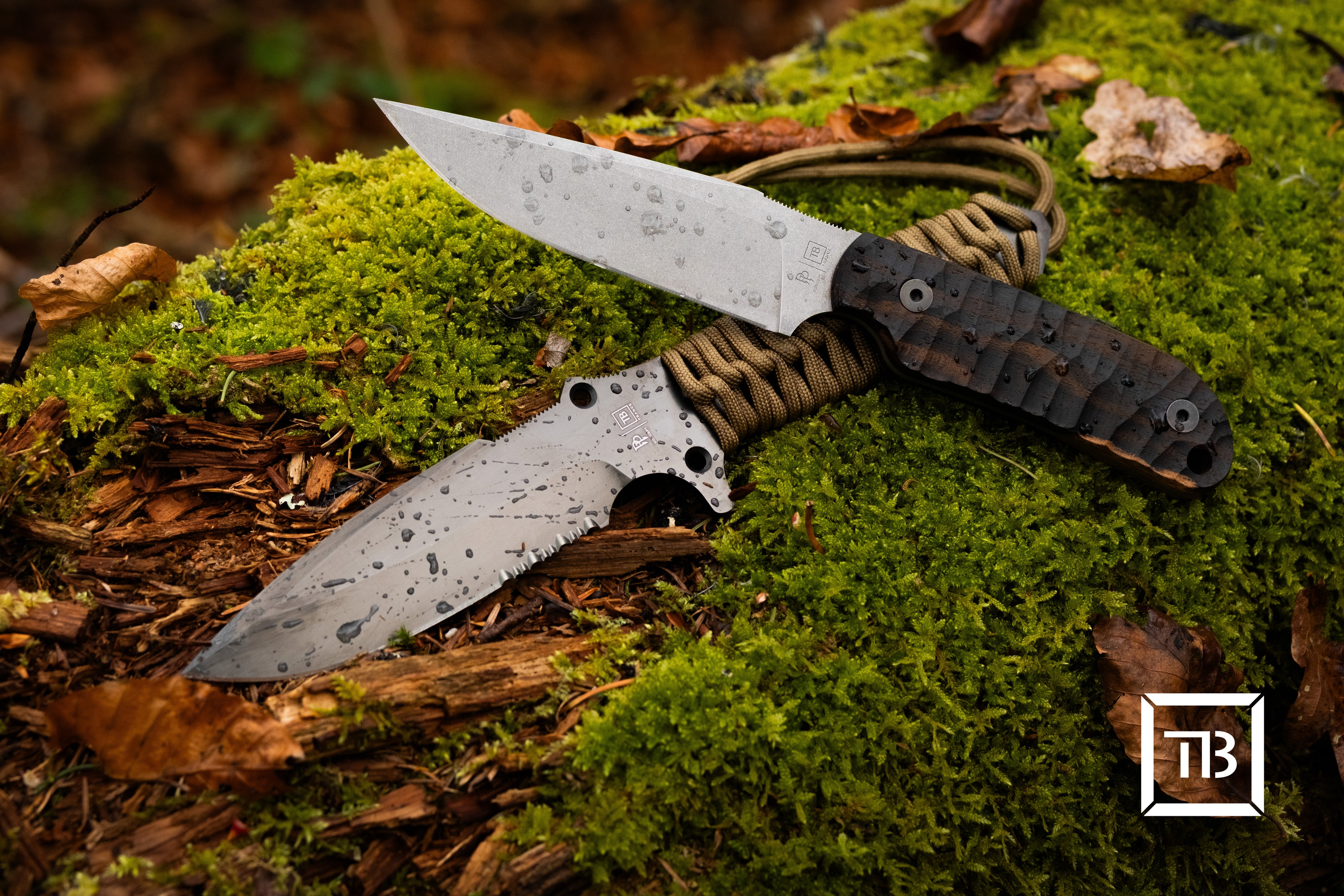

A TB Outdoor knife is much more than a tool: it's an investment in French craftsmanship, an adventure companion built to last. To maintain its cutting performance and legendary robustness, simple maintenance is key. It all comes down to three fundamental steps: immediate cleaning, regular sharpening, and targeted lubrication of the mechanisms. By adopting these best practices, you preserve the effectiveness of our high-performance steels, such as Nitrox® and MOX®, and ensure your knife has exceptional longevity.
What are the key points to remember?
- Clean and dry: After each use, clean the blade with soapy water and dry it immediately to prevent corrosion.
- Sharpen regularly: Light but frequent sharpening is more effective and safer than a complete overhaul of a dull blade.
- Lubricating folding knives: A drop of oil on the pivot of folding knives ensures smooth opening and protects the mechanism.
- Respecting steel: Even the best stainless steels like Nitrox® benefit from rigorous maintenance to express their full potential.
Why is maintaining your TB Outdoor knife so important?
Choosing a knife from Tarrerias-Bonjean cutlery means trusting a tradition that dates back to 1648. It means equipping yourself with a product made in France and proven by the demands of the field. Such a tool, designed for efficiency and safety, deserves care that matches its quality to maintain its performance for years to come.
Whether you own a robust fixed-blade knife like the Marauder® or a tactical folding knife such as the CAC® These few simple steps will guarantee the maximum durability of your equipment. It's the difference between a knife that wears out and a knife that develops a patina.
What are the 3 essential steps for a perfect interview?
Simple, regular maintenance is always preferable to major repairs on a damaged tool. Incorporate these three habits into your routine to keep your blade looking like new.
Step 1: How to properly clean your blade?
This is the simplest, but also the most crucial, step to prevent corrosion, even on so-called "stainless" steels.
- Washing: After each use, especially after cutting acidic foods (lemon, tomato) or after contact with salt water, clean the blade with warm water and mild soap.
- Drying: This is an essential step. Immediately and thoroughly dry the entire knife with a soft, dry cloth. Leave no trace of moisture.
- For folding knives: Pay particular attention to the mechanism (Axis lock, Liner lock, etc.). Rinse and thoroughly dry the inside of the handle to prevent debris or moisture from getting trapped inside.
- The advantage of fixed blades: Their one-piece construction (full tang) and the absence of moving parts make fixed blade knives easier and faster to maintain.
Step 2: How to maintain optimal sharpness?
A well-maintained blade edge is not only more efficient, it's also safer. A blade that cuts perfectly requires less force and is less likely to slip.
- Frequency: Don't wait until your blade is completely dull. Light and frequent sharpening is much easier and better preserves the steel.
- Equipment: Use quality equipment. A sharpening stone, a diamond sharpening steel, or a controlled-angle system will give excellent results.
- The angle: For our blades, we recommend a sharpening angle indicated on each product page. Maintaining this angle is essential for achieving a good cutting edge.
Step 3: Why and how to lubricate your folding knife?
This step is crucial for all folding models ( CAC® , Bivouac®, Baroudeur®). It ensures the smooth operation of the mechanism and its long-term protection.
- The action: Apply a single drop of light oil (mineral oil, gun oil or specialized lubricant) directly onto the pivot point of the blade.
- The procedure: Open and close the blade several times to distribute the lubricant evenly, then wipe off the excess with a clean cloth.
- The benefits: This simple action makes opening easier, makes the mechanism more pleasant to use and protects internal parts from corrosion and wear.
How to care for nitrox® and mox® specific steels?
We use technical steels for their cutting and strength properties. Proper maintenance allows you to get the most out of them.
| Steel | Main characteristic | Specific maintenance advice |
|---|---|---|
| Nitrox® | Nitrogen-enriched stainless steel for excellent corrosion resistance and superior cutting performance. | Despite its high resistance, immediate drying (step 1) remains imperative to maximize its lifespan, especially after exposure to salt. |
| MOX® | High-performance steel ensuring a durable cutting edge and high robustness, ideal for heavy-duty use. | This highly resistant steel reveals its full potential with regular sharpening (step 2) which effortlessly maintains the edge of the blade. |
Simple maintenance for a lasting investment?
A TB Outdoor knife is designed for action and built to last. By following these three simple steps—cleaning, sharpening, and lubricating—you ensure that your tool, the product of over five centuries of expertise, remains a trusted partner for all your adventures.
With this minimal maintenance, you transform your purchase into an heirloom. A knife that will faithfully accompany you, year after year.
Discover our maintenance accessoriesFrequently Asked Questions (FAQ)
How often should I sharpen my knife?
It depends on how you use it. For regular use, a quick pass over a sharpening steel once a week may suffice. If you use it intensively (bushcraft, woodworking), a more thorough sharpening after each heavy outing is good practice. The key is to never let it become completely dull.
Can I put my TB Outdoor knife in the dishwasher?
No, it is strongly discouraged. Harsh detergents, intense heat, and prolonged humidity in a dishwasher can damage the steel, the blade's surface treatment, and the handle materials. Hand washing is the only recommended method.
What type of oil should be used for lubricating the pivot?
A fine, high-quality oil is ideal. You can use a food-grade mineral oil if your knife will be in contact with food, a gun oil, or a specialized knife lubricant. Avoid vegetable oils (like olive oil) which can turn rancid and cause the mechanism to gum up.