How to sharpen an outdoor knife?
In the heart of the wilderness or on an operational mission, a high-performance edge is synonymous with efficiency and safety. At TB-Outdoor, we equip armed forces with technical blades designed to withstand the harshest constraints. But even exceptional steel dulls with intensive use in the field. From the Nitrox® steel of the C.A.C.® to the MOX® of our fixed-blade knives, each steel requires a pragmatic approach to regain a formidable edge. This guide provides you with field techniques to master the art of tactical sharpening without heavy equipment.
- Operational consistency: Sharpen often and with light touches rather than forcing on a dull blade.
- Cutting angle: Maintain a constant angle (generally between 17 and 20 degrees per side) to ensure edge robustness.
- Portable tools: Use our pocket diamond sharpeners to restore an optimal edge directly at camp.
When should you sharpen a knife?
Signs of a dull blade
The knife slides over the material instead of biting, cutting wood or straps requires unusual effort, or the blade tears instead of slicing cleanly. Visual inspection reveals micro-reflections on the edge, proof that it is flat and no longer V-shaped.
What not to wait for
Do not wait until the blade is completely chipped or dull. Light, regular maintenance in the field takes less than three minutes and preserves the blade's original geometry.
Different sharpening methods
Stone
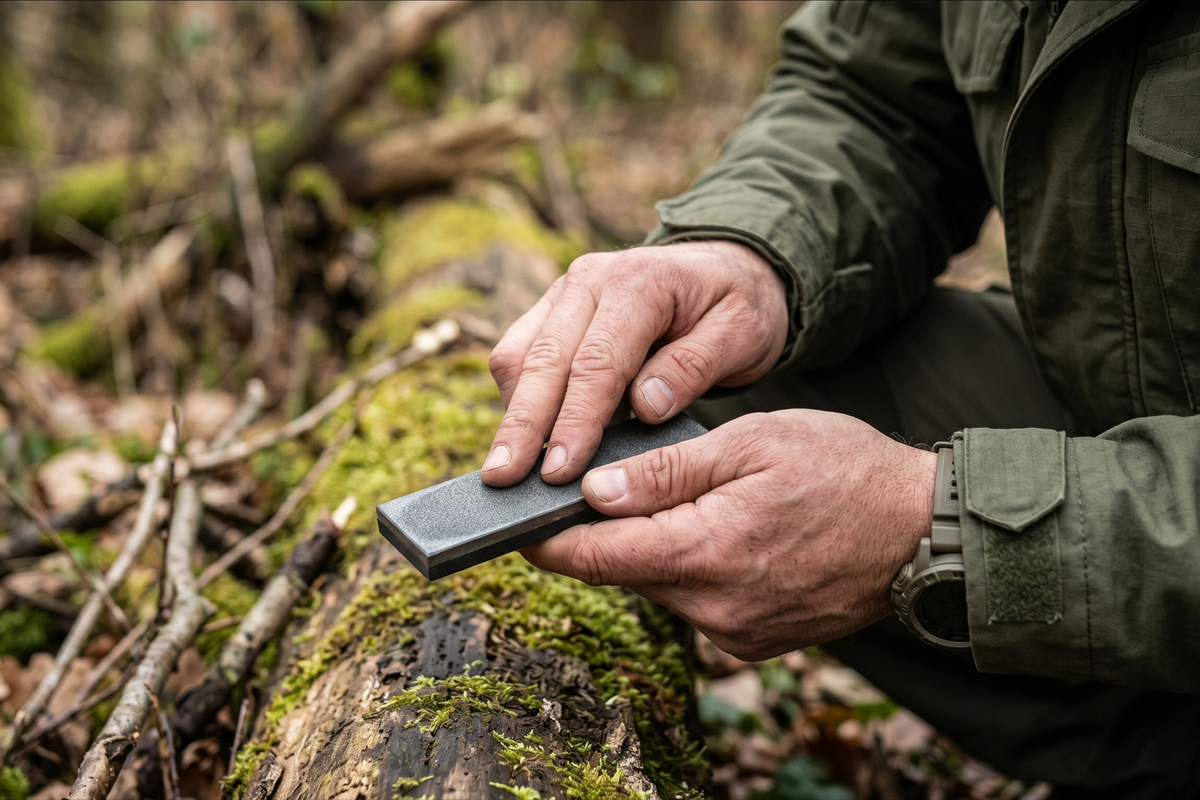
The basic method. A dual-grit stone (coarse and fine) allows you to restore the edge and then polish it. Ideal for fixed-blade knives during an extended stay at base camp.
Compact sharpener
Essential in a backpack. The Folding diamond sharpener (€15.00) and the Diamond sharpener in Kydex sheath (€18.00) allow for quick and precise intervention directly in the field, without bulk.
Guided system
Ideal in the workshop or at a permanent camp. It maintains the angle automatically for a professional-quality finish on technical blades.
Honing rod or leather: useful or not?
The rod is useful for realigning an edge that has simply rolled. Leather with polishing compound helps achieve a razor-sharp edge after the stone step.
Steps to properly sharpen your blade
Prepare the equipment
Stabilize your support (stone or sharpener). Ensure the surface is clean and free of residues that could scratch the blade or the PVD coating.
Find the right angle
For an outdoor knife, an angle of 17 to 20 degrees per side is the standard. For example, the C.A.C.® has a very precise factory sharpening angle of 17° per side (34° total) that you should strive to maintain.
Work consistently
Perform regular movements starting from the guard towards the tip. Apply light pressure to avoid damaging the edge.
Check the edge
Gently pass your thumb (from the back of the knife towards the edge, never in the other direction) to detect the presence of the burr, a small metal ridge indicating that the angle has been reached.
Finish cleanly
Switch to a very fine grit or use the ceramic side to remove the burr and polish the edge.
Errors to absolutely avoid
Applying too much pressure
Technical steel does not need to be deeply ground with every pass. Removing too much material unnecessarily reduces the blade's lifespan.
Wrong angle
An angle that is too open destroys cutting ability, while an angle that is too closed weakens the edge during heavy-duty work.
Burning or damaging the edge
Using a high-speed electric grinder without cooling can temper the steel. Always use manual tools or portable diamonds.
Using an unsuitable tool
Using a stone that is too abrasive on hard steel (like MOX®) creates micro-chips on the cutting edge.
Sharpening according to knife type
Folding knife
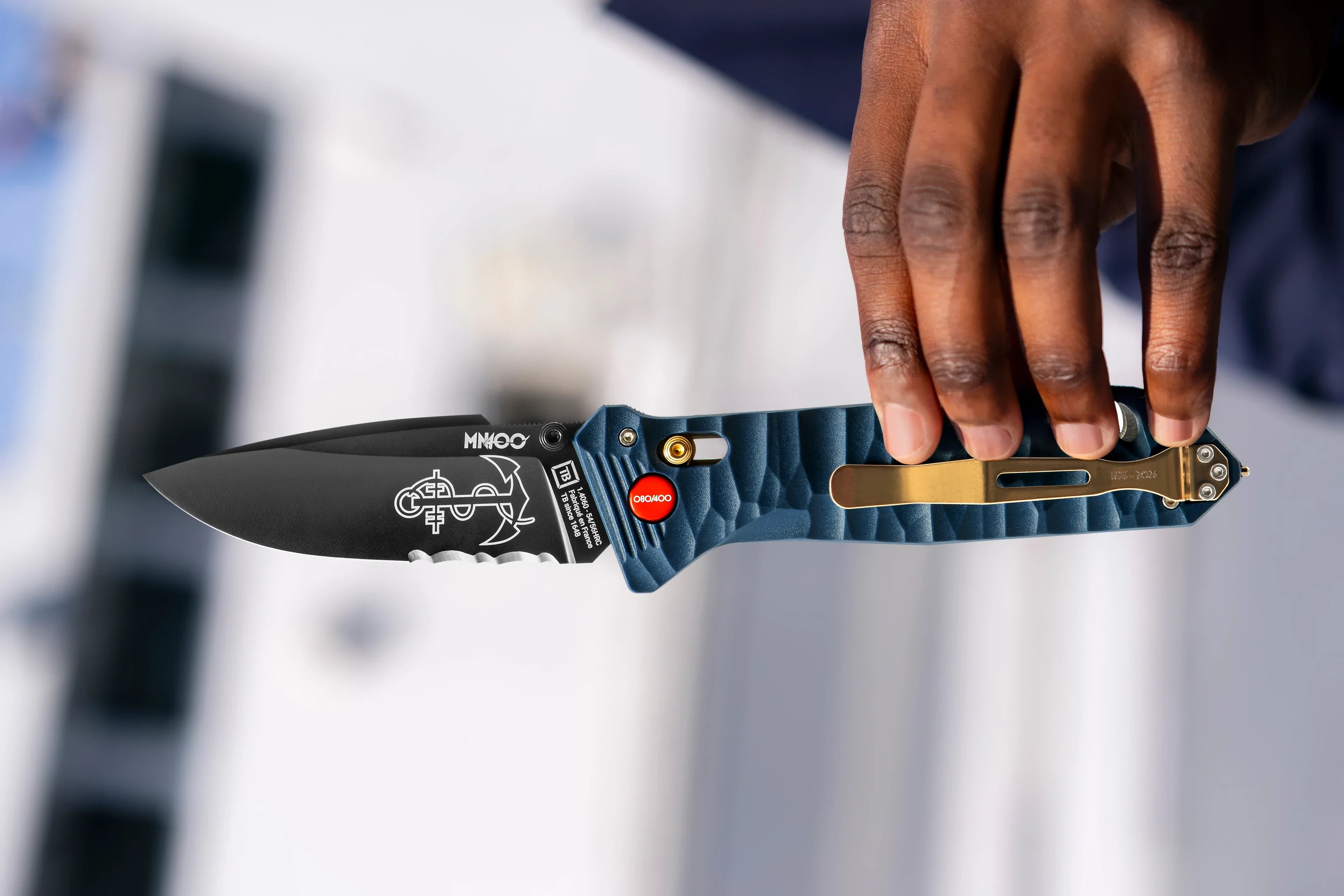
Sharpening a knife equipped with a secure mechanism (like the Axis-lock type locking system on the C.A.C.® or the liner-less system on the Unboxer®) requires care not to clog the pivot with metal dust. You can find all our models in the Folding knives category.
Fixed-blade knife
For the maintenance of very hard steels (hardness of approximately 58 HRC) like the MOX® on the Maraudeur®, use our brand's diamond sharpeners. You can view our models in the Fixed-blade knives category.
Thick blade / thin blade
The Impact 127® has a deliberately more open cutting angle (35° total) to ensure extreme solidity during batoning. It is necessary to keep this specific geometry angle during sharpening.
| Model | Steel | Recommended angle |
|---|---|---|
| C.A.C.® | Nitrox® | 17° per side (34° total) |
| Maraudeur® | MOX® | 20° per side (40° total) |
| Dravik® | Acuto 440 | 15-17° per side (Razor edge) |
FAQ
- Question: How to restore the edge of a MOX® steel knife in the field? Answer: With a hardness of approximately 58 HRC, this steel retains its edge for a very long time but requires the use of a high-performance tool like the TB-Outdoor diamond sharpener to effectively restore the edge.
- Question: What is the optimal angle for a survival knife? Answer: An angle of 20 degrees per side (40° total) offers an optimal compromise between impact resistance and cutting power in hostile environments.
- Question: How do you clean a diamond sharpener? Answer: Use lukewarm water and a soft brush to remove metal particles accumulated in the grit.