
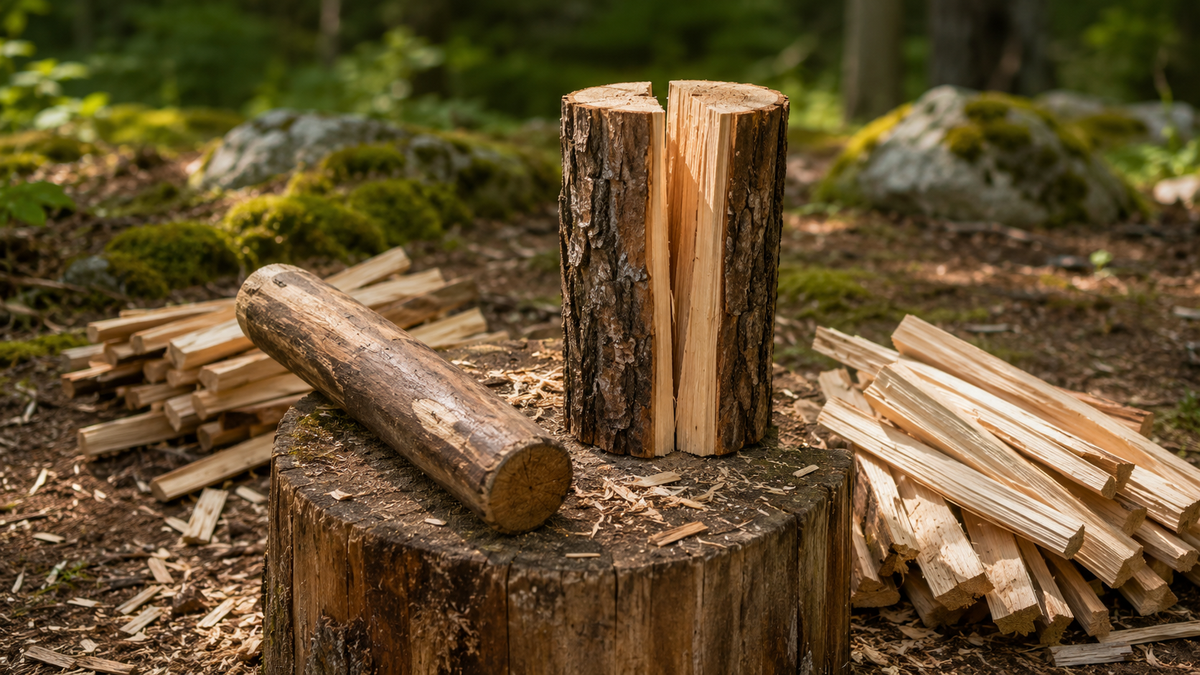
Batoning is one of the most useful — and most poorly executed — bushcraft techniques. It allows you to split wood without an axe or saw by striking the spine of a fixed blade with a baton to drive it through a log. When done correctly, it is a safe and efficient way to produce dry kindling. When done incorrectly, it is one of the most frequent causes of injuries in outdoor use. Here is the correct technique and the mistakes never to make.
The Principle of Batoning
Batoning involves placing the blade perpendicularly on a section of wood, with the tip embedded in the wood, then striking the spine of the blade (the non-sharp part) with a sturdy stick to advance the cut. Repeated in successive passes, this action allows you to split a log with the grain, produce calibrated kindling, or expose the dry heart of a piece of wood that is wet on the surface.
This technique effectively replaces an axe for preparing kindling — a central use in bushcraft and survival, where the bulkiness of an axe is not always justifiable.
The 5 Safety Mistakes Never to Make
1. Batoning with a knife pointed towards you
This is the most dangerous and common mistake. The blade should always be oriented in a direction where, in the event of a slip or wood breakage, it cannot move towards the user's body. The log should be positioned so that the blade's trajectory, if it continues its movement beyond the wood, moves away from you and anyone nearby.
2. Not clearing a safety zone around you
Before starting, you must ensure that no part of your body — hands, legs, feet — is in the path of the blade's progression or within the striking stick's range of motion. An unstable position or a knee too close to the log turns a minor slip into a serious injury.
3. Using a folding knife
Batoning subjects the blade to bending and repeated impact — exactly the stresses that a folding mechanism is not designed to absorb. Even a robust folder like the C.A.C.® is not intended for this use: the risk of accidental closure on fingers exists, even with a reliable locking system. Batoning is reserved for fixed blades.
4. Not checking the condition of the wood before striking
A hidden knot, a frost pocket in winter, or an internal crack can unpredictably deflect the blade or cause the wood to split suddenly. A quick examination of the log — looking for visible knots, testing the texture — significantly reduces this risk.
5. Striking with an unsuitable baton
A baton that is too light will not have enough inertia and will force you to strike harder and less precisely. A baton that is too heavy or knotty can slip on the spine of the blade and deflect the strike. The right baton is a piece of hard, dry wood, comfortable to hold, without unpredictable snags.
The Correct Technique, Step by Step
- Choose an appropriate fixed blade — with a straight and thick spine, without a fragile coating on the striking area.
- Position the log vertically on a stable base (stump, larger log), never held by hand.
- Engage the tip of the blade in the wood, at the desired spot, with the blade facing away from you.
- Strike the spine of the blade with the baton, with regular and controlled blows — not violent and uncontrolled strikes.
- Advance the blade in successive passes until it completely passes through the section.
- Check the edge after use — batoning heavily stresses the blade's edge; resharpening is often necessary after an intensive session.
Which TB-Outdoor Blade for Batoning?
Beware of a common shortcut: among the three regulated TB-Outdoor knives (Bivouac®, Baroudeur®, C.A.C.®), none are fixed blades — they are all folding knives, including the Baroudeur® which is distinguished by its independent camp cutlery (spoon, fork), not by its blade type. For batoning, you need to turn to the true fixed blades in the range:
- Maraudeur® — a full-tang dagger (the blade's steel runs the entire length of the handle), MOX® steel at 58 HRC, explicitly designed to withstand batoning without risk of breakage. It is the TB-Outdoor reference for this use.
- Commandeur® — a dagger developed with Philippe Perotti, Alenox® steel (minimum 18% chromium), designed for intensive outdoor cutting.
Frequently Asked Questions About Batoning
Can you baton with any fixed blade?
No. A thin blade or one with heat treatment focused solely on hardness (low toughness) can crack or chip under repeated impacts. A blade designed for intensive outdoor use, with a suitable spine geometry, is necessary.
Does batoning damage the blade?
Properly executed batoning, with a suitable blade, does not damage the tool beyond normal edge wear. The risk of damage almost always comes from poor technique or an unsuitable blade choice (folding knife, too thin blade).
Wearing gloves is not mandatory but recommended, especially for the hand holding the striking baton — it protects against splinters and improves grip in wet conditions.
→ Discover the Maraudeur®, the TB-Outdoor fixed blade designed for batoning