Choosing a tactical knife is an important decision. It's an essential tool for your outdoor activities, bushcraft, or survival situations. A good knife is a reliable partner you should be able to count on. A poor choice, on the other hand, can quickly become a safety or effectiveness problem in the field.
With hundreds of models available, it's easy to make a mistake. An aggressive look can sometimes hide poor performance. Low-quality steel can fail you at the worst possible moment. This article guides you to avoid common errors. We help you choose an effective and durable tool for all your adventures.
What are the key points to remember?
- Steel above all: The grade of steel determines cutting performance, robustness, and corrosion resistance. This is non-negotiable.
- Function over form: Spectacular design does not guarantee performance. Always prioritize efficiency and simplicity.
- Ergonomics is essential: An excellent knife with a poor grip is a dangerous and tiring tool.
- Size and profile matter: A blade must be suited to your actual needs. Not too large, not too specialized.
- The sheath is part of the knife: Neglecting the quality of the carrying system will render your knife useless.
What are the 5 mistakes to avoid when choosing a tactical knife?
Mistake #1: Why is the steel of the blade the number one criterion?
This is the most fundamental mistake. Focusing on looks while forgetting that the heart of a knife is its steel. Poor-quality steel dulls quickly. It can rust in a matter of days or break under stress. The performance of your tool depends directly on the steel.
Stainless steel or carbon steel: which to choose?
There's no perfect answer; it's a compromise. Carbon steel (type 1095) is robust and easy to sharpen in the field. Its weakness is its susceptibility to rust, requiring constant maintenance. Stainless steel (like our MOX® or Nitrox® steels) is much more resistant to corrosion, a real advantage in humid environments. Modern high-end steels combine the best of both worlds.
Is hardness (HRC) the only indicator?
No, and that's a common mistake. Rockwell hardness (HRC) measures edge retention. An HRC of 58-60 is very good. But without good toughness (impact resistance), the blade will be brittle. Therefore, the heat treatment of the steel is just as crucial as its chemical composition.
Mistake #2: Is aggressive design a guarantee of performance?
This is a beginner's mistake, often influenced by movies. Blades with complex shapes, unnecessary saws, or multiple points are almost always less effective. A tactical knife is a tool, not a display piece. Simplicity is key to strength and efficiency.
What differentiates a tool from a collectible?
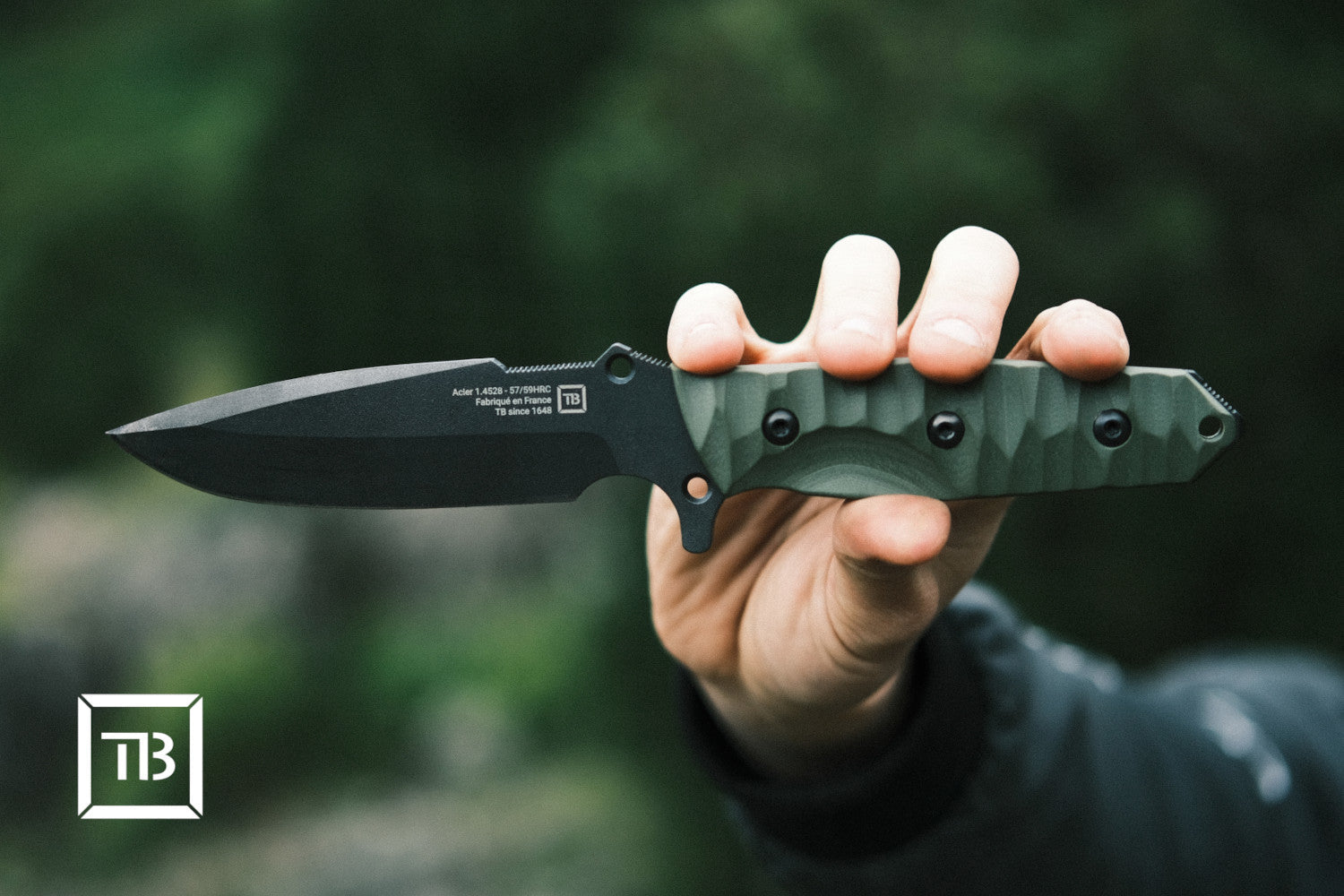
A tool is designed to be functional. Every element has a purpose. A thumb rest improves control. A flat pommel can be used as a hammer. A blade profile (drop point, tanto) is suited to specific tasks. A collector's item prioritizes aesthetics. Ask yourself this simple question: "Does this feature help me cut better?"
Mistake #3: How can poor ergonomics ruin your knife?
You can own the best blade in the world. But if the handle is slippery or poorly shaped, your knife becomes dangerous. A bad grip causes fatigue and, more importantly, increases the risk of slipping and injuring yourself. Ergonomics is your safety.
What materials should be preferred for the handle?
Modern composite materials are the standard. Two options stand out for heavy-duty use:
- G10: A virtually indestructible fiberglass and resin composite. It is impervious to water and temperature variations. Its texture provides exceptional grip, even with gloves.
- Glass fiber reinforced PA6: A reinforced polymer that gives it extreme strength and rigidity. It absorbs impacts and resists abrasion. It's the principle of reinforced concrete applied to a handle.
These two materials are far superior to hollow plastics or untreated wood.
Mistake #4: Are the size and shape of the blade really that important?
Yes. Thinking "bigger is better" is a common mistake. A large blade is heavy and unwieldy for delicate tasks, like preparing a fire. A blade that's too short lacks versatility for tougher jobs. Your primary use should dictate your choice.
Fixed blade or folding blade: which is the right tactical choice?
For survival or bushcraft, robustness is paramount. A fixed blade is then the only viable option. Its full tang construction (the blade runs the entire length of the handle) offers maximum strength. The folding knife, like our CAC , is perfect for discreet everyday carry (EDC). But its locking mechanism will always remain its weak point compared to a fixed blade.
Mistake #5: Why is the sheath as crucial as the knife itself?
Neglecting the sheath is the final, major mistake. A good knife in a bad sheath will be wasted, slow to draw, or damaged by moisture. The sheath connects the tool to its user. It must be secure, quiet, and compatible with your equipment.
Kydex or nylon: which is the best choice?
Kydex , a molded plastic, offers excellent retention and durability. It's the preferred choice for tactical and outdoor use. Ballistic nylon is quieter and more flexible, but it can retain moisture. For a fixed-blade action knife, like the Marauder , a MOLLE-compatible Kydex sheath is a performance standard.
By avoiding these five mistakes, you can transform a purchase into a smart investment. You're no longer choosing a look, but a high-performing and reliable tool. A companion designed to last. Browse our selection of tactical knives knowing exactly what to look for.