In the world of outdoor activities, some equipment transcends its simple function to become true icons of reliability and versatility. Paracord is undeniably one of them. Far more than just a cord, it represents a legacy of robustness, proven in the most demanding environments, notably by military forces for decades. Its reputation is well-deserved: lightweight, incredibly strong, and adaptable, it stands out as an indispensable companion for anyone venturing off the beaten path.
At TB Outdoor, drawing on our long French knife-making tradition dating back to 1648 and our experience as a supplier of equipment for demanding environments like the French Army, we consider paracord as fundamental to outdoor gear as a reliable knife or an accurate compass. It embodies the values of preparedness, self-reliance, and resilience that are dear to us and that we know are shared by adventure enthusiasts.
This article aims to reveal the many facets of this exceptional tool. We will explore in detail its countless applications, from everyday uses that simplify life while hiking and camping to vital functions in survival situations, including emergency repairs and even first aid. Get ready to discover why paracord deserves a prime spot in your backpack.
What exactly is paracord? The anatomy of an exceptional tool
To fully understand the versatility of paracord, it is essential to examine its unique structure. Commonly called "550 paracord", it typically consists of a braided outer sheath, usually made of nylon for its strength and abrasion resistance, which encloses a core made up of several independent inner strands.
The most common standard, "Type III 550," refers to a precise military specification: it contains 7 inner strands (or "yarns"), each often composed of 2 or 3 thinner strands twisted together. The number "550" indicates its minimum static breaking strength, expressed in pounds, which is equivalent to approximately 250 kilograms. This remarkable strength, combined with its lightness and compactness, makes it a major asset for adventurers looking to optimize their gear.
But the true ingenuity of paracord lies in its modular design. This multi-strand structure isn't just about overall strength; it's the key to its incredible versatility. The core can be separated from the sheath, and the inner strands can even be broken down into even thinner wires. A single meter of Type III 550 paracord can thus provide more than 8 meters of usable rope in total (the sheath plus the 7 inner strands, each potentially divisible). This ingenious design transforms a simple rope into a truly adaptable rope system. Each component—the abrasion-resistant sheath, the strong strands, the thin wires for delicate tasks—has specific properties and can be used in a targeted way for a multitude of applications, far beyond what a single-strand rope of equivalent strength would allow. It's this ability to multiply resources that makes paracord such a valuable tool in the field.
Paracord for everyday use: Simplifying life while hiking and camping
Even before considering extreme situations, paracord proves extremely useful for improving comfort and efficiency during more typical outdoor activities, such as hiking or camping. Its strength and ease of use allow you to solve many minor problems and optimize your setup.
Optimizing your campsite for greater comfort and efficiency
When camping, paracord quickly becomes indispensable:
- Sturdy tent and tarp setup: This allows you to replace or reinforce tent guy lines, or create a solid ridgeline for tensioning a tarp and providing effective shelter. Using appropriate knots, such as the clove hitch to secure the rope to a tree or stake, or the Prusik knot to create adjustable attachment points along the ridgeline, ensures a stable and secure setup.
- Practical gear hanging: No more gear lying on the ground! Paracord makes it easy to hang lamps, backpacks, mess kits, or other tools from branches or a rope stretched across the campsite. A particularly important application is hanging food out of reach of animals, an essential precaution to avoid unwanted nighttime visits and protect your supplies.
- Improvised clothesline: A simple but oh so practical use! Stretch a piece of paracord between two trees and you instantly have a clothesline to dry socks, towels or wet clothes after a downpour or a quick wash.
- Comfort in the great outdoors: With a little ingenuity, paracord can significantly improve comfort at camp. It can be used to stretch a tarp and make a makeshift hammock, create a comfortable hanging seat between two trees, or even join branches to make small, temporary camp furniture. Some even go so far as to weave an entire sturdy hammock from paracord.
On-the-ground repairs and tips: The art of improvisation
On the trails, minor equipment mishaps are common. Paracord then becomes a makeshift first-aid kit for your gear:
- Quick shoelace replacement: This is one of the best-known and most useful features. A shoelace breaking mid-hike can quickly become a problem. A piece of paracord is an excellent replacement, offering much greater strength. Some savvy hikers even proactively replace their original shoelaces with paracord for added peace of mind and to always have a spare cord on hand.
- Repairing straps and equipment: A backpack strap that breaks, a gaiter buckle that snaps, a tent attachment that gives way... Paracord allows for strong and quick repairs on many pieces of equipment.
- Emergency belt or suspenders: If your belt fails or breaks, a simple strand of paracord tied around your waist will do the trick. It can also be used to improvise or repair suspenders.
- Reinforcing or creating tool handles: The "wrapping" technique, which involves tightly wrapping paracord around a handle, significantly improves the grip of a knife, axe, or other tool. It can also be used to create a makeshift handle if the original is broken, by wrapping the paracord directly onto the tool's tang. An instructional video demonstrates how to create a protective wrap for an axe handle.
- Other practical uses: The list is long! Paracord can be used as an emergency elastic for tying long hair, an improvised leash for a dog or other animal, a mooring rope for a canoe or small boat, or even as a measuring tool if its length is known precisely.
Thus, paracord demonstrates its dual value in everyday life: it not only allows you to actively optimize your comfort and setup during a planned outing, but it also proves indispensable for reacting effectively to minor unforeseen events, such as a broken shoelace or a failing fastener. It's not just a backup tool, but a true partner for enhancing your entire outdoor experience.
When the unexpected happens: Paracord, your ally in survival situations
While paracord greatly simplifies life on typical hikes, it's in unexpected or survival situations that its true value shines and it can become a potentially vital tool. Its strength and versatility allow it to meet basic needs: providing shelter, making a fire, finding food and water, and administering first aid.
Building an emergency shelter: Protecting yourself from the elements
In the face of inclement weather, having shelter is essential. Paracord is a key element for quickly building effective protection:
- Assembling natural structures: This technique allows you to securely bind branches or poles to create the frame of a simple shelter (lean-to, tipi, etc.). Knowledge of reliable knots is crucial here: the square knot to join two lengths of rope, the clove hitch to securely anchor the structure to trees, or the bowline to create strong loops.
- Securing protective tarps: Whether with a dedicated tarp, a simple plastic tarp or a survival blanket, paracord allows you to effectively tension protection against rain, wind or sun, by attaching it to the frame or directly between trees.
Mastering fire: A vital skill
Fire provides warmth, light, security, and the ability to boil water and cook food. Paracord can help achieve this.
- Effective tinder thanks to its inner strands: The very fine threads that make up the core of paracord (the 7 inner strands) can be extracted and frayed to form a cottony ball. This improvised tinder ignites very easily with the slightest spark produced by a firesteel (ferrocerium) or other means. It is a valuable resource, especially in damp weather when finding dry, natural tinder can be difficult. Some survival bracelets even incorporate a small firesteel directly into their loop.
- Firebow technique (bow drill): For more experienced users, paracord can be used as a bowstring in the friction method known as "bow drill." By rapidly rotating a wooden drill bit on a board, an ember is created. It should be noted that this technique requires some skill and that the sometimes smooth surface of paracord can make it slippery. To improve friction, it is recommended to use two strands of paracord twisted together or to wrap the cord several times around the drill bit.
Providing for one's subsistence: Fishing, hunting and trapping
In a prolonged survival situation, finding food becomes a priority. Paracord offers several possibilities:
- Fishing: The thinnest inner strands can be used as fishing line. Of course, you'll need hooks or the ability to improvise some (from wood, bone, metal, etc.). Paracord (inner strands or sheath) can also be used to braid a trap, a small net, or a landing net. Simple lures can even be made by fraying the end of a piece of paracord and attaching a hook.
- Trapping: Paracord is ideal for making snares to capture small game. Its strength allows for the creation of effective traps. The inner strands can be used for more sensitive trigger mechanisms, such as in the Paiute Deadfall trap.
- Hunting: For more active needs, paracord can be used to make a bowstring for an improvised bow from a flexible branch. It can also be used to securely attach a point (knife, chipped stone) to the end of a stick to create a spear. Other primitive weapons can be made, such as a sling (for throwing stones) or a bola (a throwing weapon made of weighted cords, effective for capturing birds or small game by becoming entangled in their legs). Once the prey is caught, the paracord can be used to hang it up, protecting it from predators or preparing it for hunting.
First aid procedures: Stabilize and transport
In case of injury, paracord can be used for emergency first aid:
- Immobilization: It can be used to create a tourniquet to stop severe arterial bleeding (use with caution and as a last resort). It is very useful for making a splint by securely fixing rigid supports (branches, rolled-up floor mats, etc.) on either side of a fractured or suspected fractured limb. It can also be used to make a makeshift sling to support an injured arm or dislocated shoulder, to hold dressings in place, or to stabilize a sprained joint.
- Improvised sutures: In the case of an open wound and in the absence of medical supplies, the finest threads of the paracord core can, after being sterilized (for example, by flame or in boiling water if possible), be used to make rudimentary stitches. This is an extreme measure that requires great care and expertise to avoid infection.
- Transport: If an injured person is unable to move, paracord can be used to make a makeshift stretcher by securely stretching a strong fabric (tarp, jacket, etc.) between two long poles. It can also be used as a rope to help lift or lower a person up or down a steep slope.
Other critical uses in survival
The versatility of paracord extends to other crucial applications:
- Navigation and Signaling: Pieces of brightly colored paracord can be attached to branches to mark a route and prevent getting lost. It can also be used to hang bright objects or clothing high up to create visual signals for potential rescuers.
- Safety: Stretched between two points, it can serve as a guideline (handrail) for safe progress on difficult terrain, at night or in poor visibility. It allows you to secure yourself to a tree to sleep high up, protected from dangers on the ground, or to serve as a rescue rope to help someone who has fallen into water or a crevasse. A lesser-known but ingenious use is its ability to cut through plastic ties (such as self-locking cable ties) by rapid friction.
- Self-defense: Although not its primary function, in extreme situations, paracord can be used as an improvised weapon: a whip, a club by tying a heavy "monkey fist" knot at its end, or by attaching a stone to it. It can also be used for tying up.
It is essential to understand, however, that paracord, as powerful as it is, acts as a catalyst for your skills. To fully utilize its capabilities in a survival situation, whether for building a shelter, starting a fire, or finding food, mastering basic techniques (knots, construction, navigation, first aid, etc.) remains paramount. Owning paracord is an excellent first step, but investing in learning and practicing survival and bushcraft techniques is essential to unlocking its full potential. It is the combination of the right tool, like those we strive to offer at TB Outdoor, and the necessary expertise that truly makes the difference when the unexpected happens.
Mastering paracord: Essential knots for the outdoors
As we just pointed out, simply owning paracord isn't enough; you also need to know how to use it effectively. And at the heart of this effectiveness lies knowledge of knots. A poorly chosen or incorrectly tied knot can have unfortunate consequences: it can slip under tension, come undone at the wrong moment, or conversely, tighten to the point of becoming impossible to untie.
Choosing the right knot for the right application is therefore crucial. This not only ensures safety (for example, using a reliable bowline for a belay loop) but also optimizes rope usage (for example, a Prusik knot for tensioning a tarp in an adjustable way). Fortunately, it's not necessary to know dozens of complex knots. A few basic knots, when mastered, cover the vast majority of outdoor needs.
Here is a selection of fundamental knots, often cited as essential for outdoor activities and survival:
- Clove Hitch: Ideal for quickly attaching a rope around a stake, post, or tree branch. It has the advantage of being easy to tie and adjust in length. However, it is less reliable on square-section objects.
- Bowline Knot: This is THE knot for creating a secure and strong loop at the end of a rope. Its main advantage is that it doesn't slip or tighten under tension, while remaining relatively easy to untie even after bearing a heavy load. Essential for belaying, hauling, or creating reliable anchor points.
- Square Knot: Primarily used to join two strands of rope of similar diameter. Useful for lengthening a rope that is too short, for example, to reach a distant anchor point when setting up a tarp. Be careful, it can tend to slip if the ropes are of different diameters or very smooth.
- Prusik knot: This is a self-locking friction knot. Made with a thinner cord (perfect for a strand of paracord) around a thicker rope (the ridgeline of your tarp, for example), it locks firmly under load but can be moved by hand when slack. Very practical for tensioning a tarp, creating adjustable attachment points on a taut rope, or in climbing for self-belaying.
- Slipknot: Very simple to tie, it forms a loop that tightens when the standing end is pulled. Useful for quickly tying something, as a base for other knots, or for certain types of snares. However, be aware that it can slip or come undone if the tension is not constant.
We strongly encourage you to practice these knots regularly so they become second nature. This mastery will allow you to get the most out of your paracord in all circumstances.
Keeping your paracord always within reach: practical solutions
Having paracord is one thing, being able to access it quickly when needed is another. A rope buried at the bottom of your bag and completely tangled loses much of its usefulness in an emergency. Fortunately, there are several methods for carrying and storing your paracord efficiently.
- Classic storage: How to store your rope efficiently. The simplest method for transporting a significant length of paracord (15m, 30m or more) is to store it properly to avoid knots. The "hank" technique (winding into a skein) is particularly effective: wrap the rope around your hand and elbow, then use the remaining end to secure the skein by wrapping it around and looping it at the end. Paracord stored this way unwinds easily and without tangling.
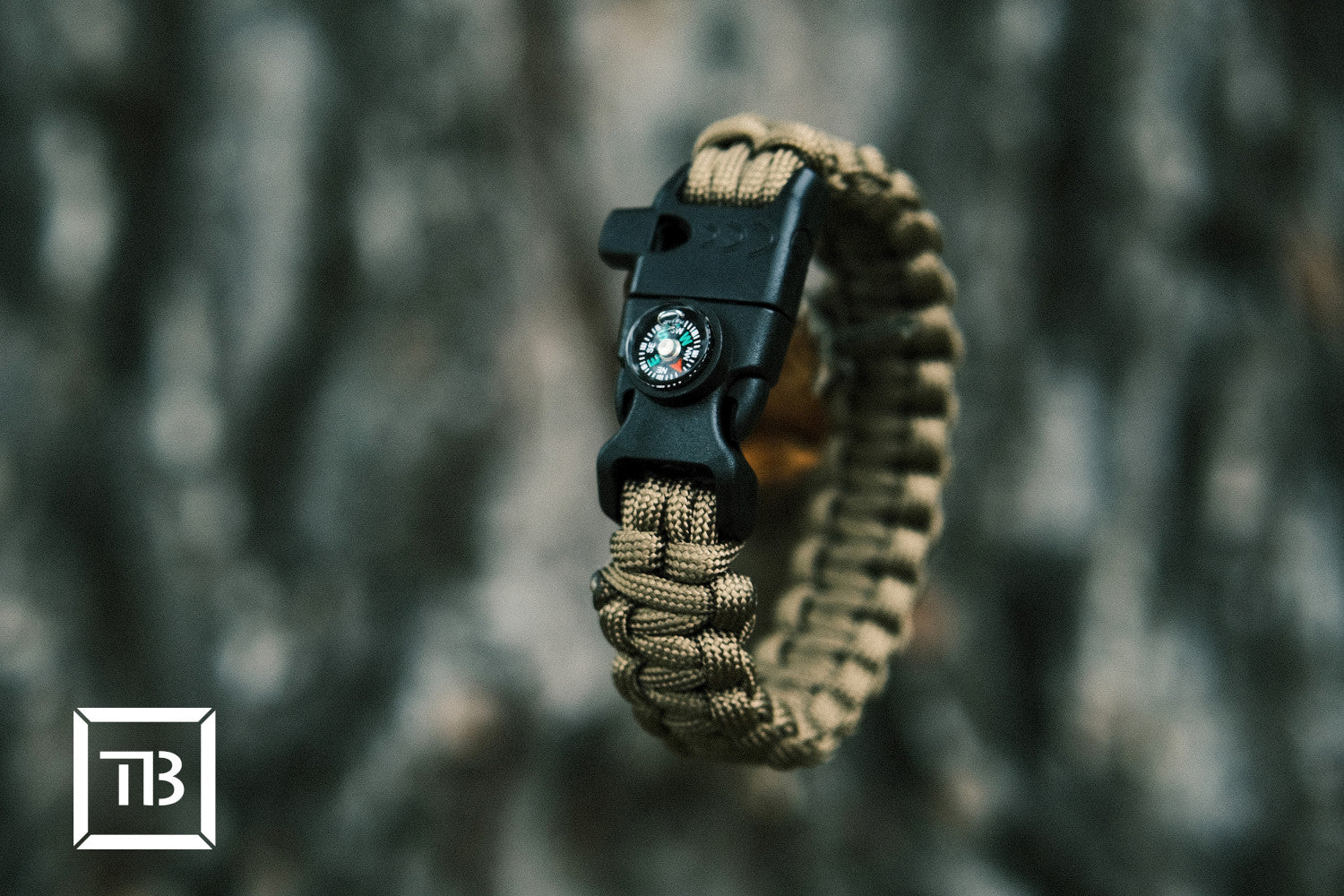
- The survival bracelet: The clever and multifunctional accessory. It's undoubtedly the most popular way to always have a supply of paracord on hand. Braided around the wrist, the survival bracelet typically contains between 3 and 5 meters of cord, ready to be untied if needed. Many models also incorporate other useful small tools: a fire starter, a distress whistle, a small emergency knife, or even a mini-compass. It's a discreet and practical way to increase your preparedness.
-
Choosing the right bracelet or paracord: Quality criteria. Whether you opt for a bracelet or loose cord, certain criteria are important:
- Rope length: For a bracelet, aim for at least 3 meters once untied. For loose rope, 15 to 30 meters is a good starting point.
- Rope quality: Always choose genuine Type III 550 paracord (250 kg breaking strength) made of nylon, recognizable by its 7 inner strands. Beware of low-quality imitations. Check its suppleness.
- Knot type (for bracelets): Some braids ("cobra", "king cobra"...) are more common but can be time-consuming to undo. Others ("quick deploy") are designed to untie very quickly.
- Clasp quality (for bracelets): Make sure the clasp (often a plastic buckle or a metal shackle) is strong and reliable so you don't lose your bracelet.
- Additional features: Evaluate the actual usefulness and quality of the tools integrated into the bracelets (whistle, firesteel...).
- Creative alternatives: Incorporate paracord into your gear. There are other clever ways to carry paracord without even thinking about it: braid a keychain, permanently replace your hiking shoelaces, make a braided belt, wrap it around the handle of your knife or axe, or even create a paracord watch strap. Every meter counts!
The choice of carrying method will ultimately depend on your specific needs and your preparation philosophy. A wrist strap offers immediate access to a small amount of rope, ideal for quick emergencies or minor repairs. A skein neatly coiled in your pack provides a larger reserve for more significant tasks such as setting up a shelter or hauling gear. These solutions are not mutually exclusive; they can be judiciously combined to adapt the quantity and accessibility of your paracord to the nature and duration of your trip, thus ensuring optimal preparation.
Paracord, your reliable partner from TB Outdoor
After this detailed exploration, the key advantages of paracord become clear: its extreme versatility allows it to meet a multitude of needs, from improving everyday comfort to the imperatives of survival. Its exceptional robustness, inherited from its military origins, makes it a tool that can be relied upon in the harshest conditions. Finally, its lightness and compactness make it easy to integrate into any equipment without excessive weight.
At TB Outdoor, we are proud of our heritage and our commitment to quality, durability, and reliability. That's why we wholeheartedly recommend adding paracord to your outdoor gear. It perfectly embodies the values that drive us: a tool that appears simple, yet is remarkably well-designed, time-tested, and capable of making all the difference when it truly matters.
Our final recommendation is simple: never set off on an excursion, whether it's a short hike or a challenging trek, without a sufficient length of quality paracord and knowledge of the few essential knots to use it. It's a small addition to your gear that can have a considerable impact on your safety, comfort, and ability to cope with the unexpected.
We invite you to discover our selection of carefully chosen outdoor equipment, selected for its quality and reliability, in our online store. Feel free to also browse our other blog articles to expand your knowledge and better prepare for your next adventures.