
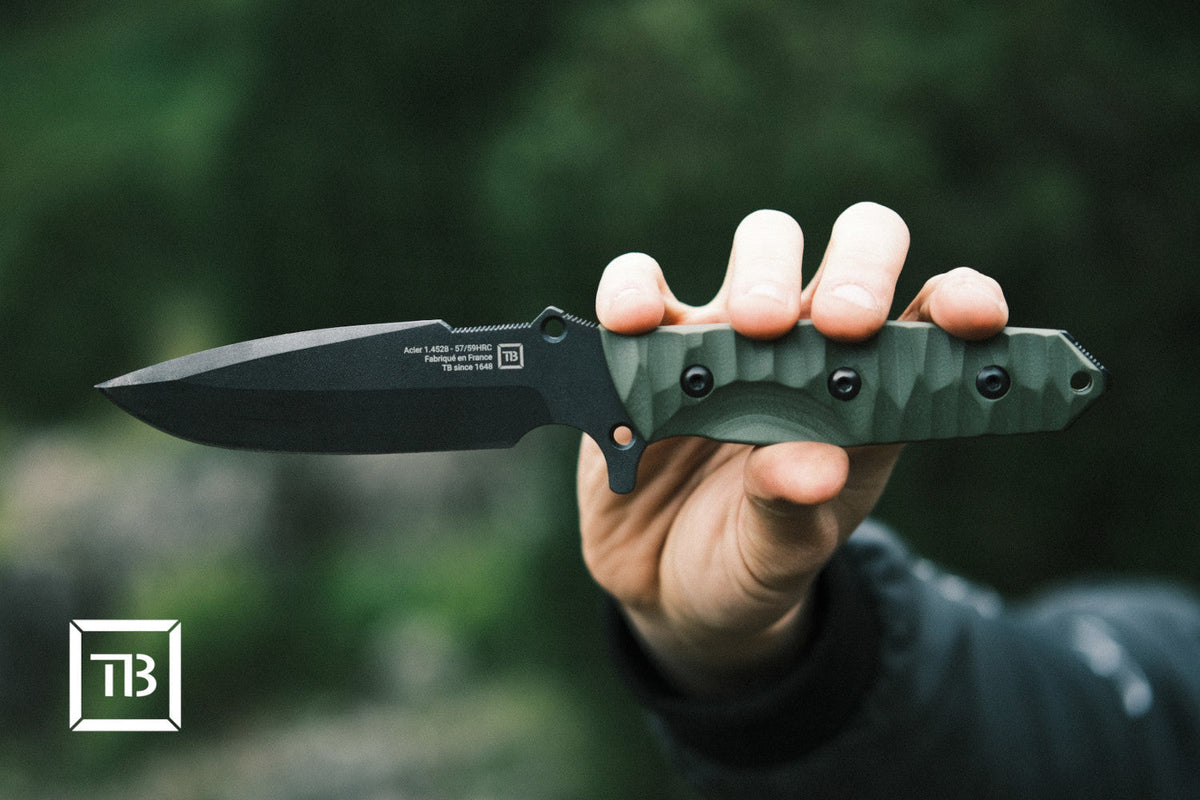
When exploring our collection of outdoor knives at TB Outdoor, you have likely noticed that we offer two types of handles: G10 and PA6 FV. Choosing the right material for your knife handle is essential, as it can have a significant impact on the tool's performance and durability. In this article, we will explain the differences between G10 and PA6 FV to help you make the choice that best suits your needs.
G10: Lightweight, Durable, and Robust
G10 is a composite material made of fiberglass impregnated with resin. After a compression process followed by baking to harden the mixture, G10 becomes a lightweight, durable, and extremely robust material. This is why it is widely used for outdoor and survival knife handles.
One of the main characteristics of G10 is its exceptional resistance. It is highly resistant to water, cold, heat, rot, and corrosion. This resistance makes G10 an ideal choice for knives that will be exposed to harsh conditions and hostile environments.
Furthermore, G10 offers excellent grip thanks to its non-slip texture. This means that even in wet or slippery conditions, you can rely on the stability of your knife. Its lightness is also an advantage, as it reduces user fatigue during long periods of use.
PA6 FV: The Robustness of Fiberglass-Reinforced Polyamide
PA6 is a type of polyamide, a technical thermoplastic. However, for our outdoor knife collection, we have chosen to use PA6 FV, which means it is reinforced with glass fibers. The addition of glass fibers creates a three-dimensional network within the material, giving PA6 FV technical properties that closely resemble those of metals.
PA6 FV offers excellent resistance to deformation, meaning it retains its shape and stability even under heavy loads. It also exhibits creep characteristics similar to those of metals, which is essential for knives that will be subjected to stress and torsion. Additionally, PA6 FV has good energy absorption capacity, making it capable of withstanding shocks and impacts.
How to Choose Between G10 and PA6 FV?
The choice between G10 and PA6 FV will depend on your personal preferences and the intended use of your outdoor knife. Here are a few points to consider:
-
Usage conditions: If you plan to use your knife in extreme conditions, where resistance to water, heat, and corrosion is essential, G10 might be the optimal choice.
-
Shock resistance: If you need a knife capable of withstanding significant shocks and impacts, PA6 FV, with its robustness and energy absorption capacity, might be more suitable.
-
Grip: Consider the texture and the feel in your hand. G10 offers excellent grip, whereas PA6 FV may have a different feel in the hand.
Ultimately, whether you choose G10 or PA6 FV, rest assured that both are high-quality materials that are carefully selected for our outdoor knives. Your choice will depend on your specific needs and personal preferences. Regardless of your choice, you can count on the quality and durability of TB Outdoor knives.
Frequently asked questions about G10 and PA6 handles
What is G10 on a knife?
G10 is a composite material made of layers of fiberglass impregnated with resin, then compressed and baked. It is lightweight, very rigid, and impervious to water, cold, heat, and corrosion. Its non-slip texture ensures a good grip, even with wet hands.
What is PA6 FV?
PA6 FV is a glass-fiber reinforced polyamide 6, a technical thermoplastic. The fibers create an internal network that gives it resistance to deformation close to that of metals. It absorbs shock energy well, making it suitable for knives used intensively.
G10 or PA6 FV: which handle to choose?
Choose G10 for humid environments and temperature variations, and for maximum grip. Prefer PA6 FV if the knife needs to withstand repeated shocks and drops. Both materials are rot-proof and durable: the choice depends mostly on usage and how it feels in the hand.
Is PA6 FV the same as FRN?
Pretty much. FRN (Fiberglass Reinforced Nylon) is the generic English name for glass-fiber reinforced nylons. PA6 FV is a specific form of it: a polyamide 6 loaded with glass fibers. G10, on the other hand, is a resin-based composite, which is more rigid and heavier than FRN.