
How to choose your survival knife without making a fatal mistake?
Choosing a survival knife is not just about selecting the biggest or most aggressive model on the shelf. It is primarily a question of consistency between the tool and your mission. An unsuitable blade in an isolated situation can turn a simple bushcraft outing into a critical situation. Based on the historical expertise of TB Outdoor, official supplier to the French armies, we analyze here the vital technical criteria. We will see why geometry, blade architecture, and steel choice are non-negotiable safety factors. Here are the 5 most common technical mistakes to avoid to ensure your autonomy in the field.
Key takeaways:
- Usage: Do not confuse a combat/rescue blade with a robust camp knife.
- Architecture: "Full Tang" is imperative for survival; a folder remains a secondary tool (EDC).
- Ergonomics: The handle must ensure grip in rain or cold (G10 vs. Paracord).
- Carry: The sheath ensures your safety and that of the blade (retention and water drainage).
- Materials: Choose steel according to the environment (Nitrox® for marine/food, MOX® for hardness).
Why should you never confuse a rescue knife with a camp knife?
This is the most common mistake among beginners: thinking that a visually aggressive tactical knife can do everything. In reality, each blade geometry corresponds to a precise physical function.
What is the classic mistake?
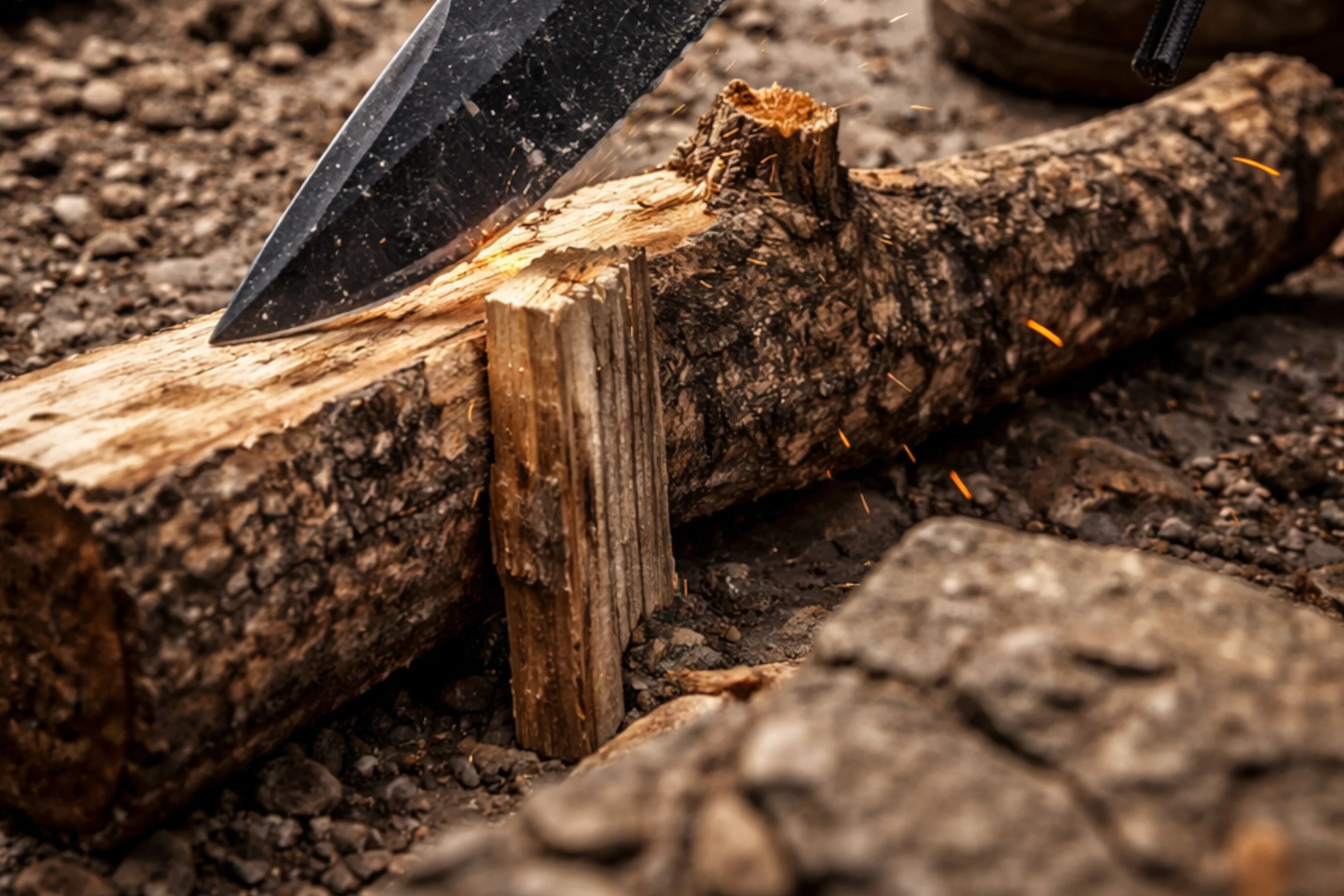
The mistake is choosing a "dagger-style" knife (double-edged or very fine point) or an extraction tool for splitting wood. These blades are designed for piercing, not for withstanding lateral impacts.
What is the reality on the ground?
Take the example of the Protecteur® model. It was designed specifically for ALAT (Army Light Aviation) pilots. Its priority is penetration, precision, and the ability to cut straps in an emergency in a cockpit. Although extremely effective in its field, its geometry is not optimized for "batoning" (splitting wood by striking the spine of the blade) or heavy-duty forest work.
What is the right choice for bushcraft?
For woodworking, shelter building, and heavy bushcraft, opt for a robust and thick profile. The Maraudeur® or the Impact 127 are specifically designed to withstand these intense mechanical stresses without weakening.
Folding or fixed blade: which architecture to prioritize for survival?
In a real survival situation, mechanical reliability is vital. The more moving parts an object has, the more likely it is to break.
Why is a folding knife risky as a primary tool?
The mistake is going into complete autonomy with a simple folding knife as the main blade. Folding knives, such as the Unboxer® or the C.A.C.®, are excellent EDC (Everyday Carry) tools. They are perfect for daily tasks, food preparation, or small cuts. However, their mechanical pivot is a structural weak point unsuitable for intensive bushcraft.
What is "Full Tang" architecture?
For survival, always favor a "full tang" construction. This means that the blade steel extends through the entire handle to the pommel. This is the case for the Maraudeur® or the Protecteur®.
To go even further in robustness, the Impact Carbon uses a "monobloc" architecture. It is machined from a single block of steel, without any welding. This offers maximum resistance to breakage, almost indestructible in the field.
How does handle choice influence your safety?
The handle is not just about aesthetics. It is your only interface with the tool. In a survival situation, you will often use your knife in degraded conditions: hands numb from cold, rain, mud, or intense stress.
- Paracord: Featured on some versions of the Maraudeur, it offers significant weight savings. More importantly, it provides a reserve of survival cord (over 250 kg breaking strength) that you can undo and use in an absolute emergency.
- G10: This composite material offers a larger grip volume. It is ideal for long tasks to prevent cramps and ensures unalterable robustness against shocks and temperature variations.
- Electrical insulation: If your mission involves electrical risks (cable cutting, urban intervention), only a specific insulating handle, like that of the Protecteur®, will guarantee your safety.
Why is the sheath as important as the knife?
A knife you cannot draw instantly, that you lose while running, or that rusts in its sheath is a danger. The classic mistake is to focus solely on the blade and forget about the carry system.
What criteria should you check on your sheath?
Which steel to choose depending on your operating environment?
Not all steels are equal. The choice is often a compromise between hardness (ability to cut for a long time) and corrosion resistance (not rusting).
When to choose MOX® steel?
For maximum hardness (around 58-59 HRC) and superior edge retention, MOX® steel is ideal. It is a high-performance martensitic stainless steel. It equips the Maraudeur and allows for a razor-sharp edge even after intensive use on hard wood.
When to prefer Nitrox® steel?
If you operate in a marine environment, very humid, or for food use, corrosion resistance is a priority. Nitrox® steel (nitrogen-doped), used on the C.A.C. or Unboxer, is preferable. It offers excellent oxidation resistance while maintaining good cutting ability.
Technical note: Do not neglect surface treatments. A black PVD coating is not just decorative. It provides vital anti-glare protection for discretion (tactical) and adds an additional physical barrier against corrosion.