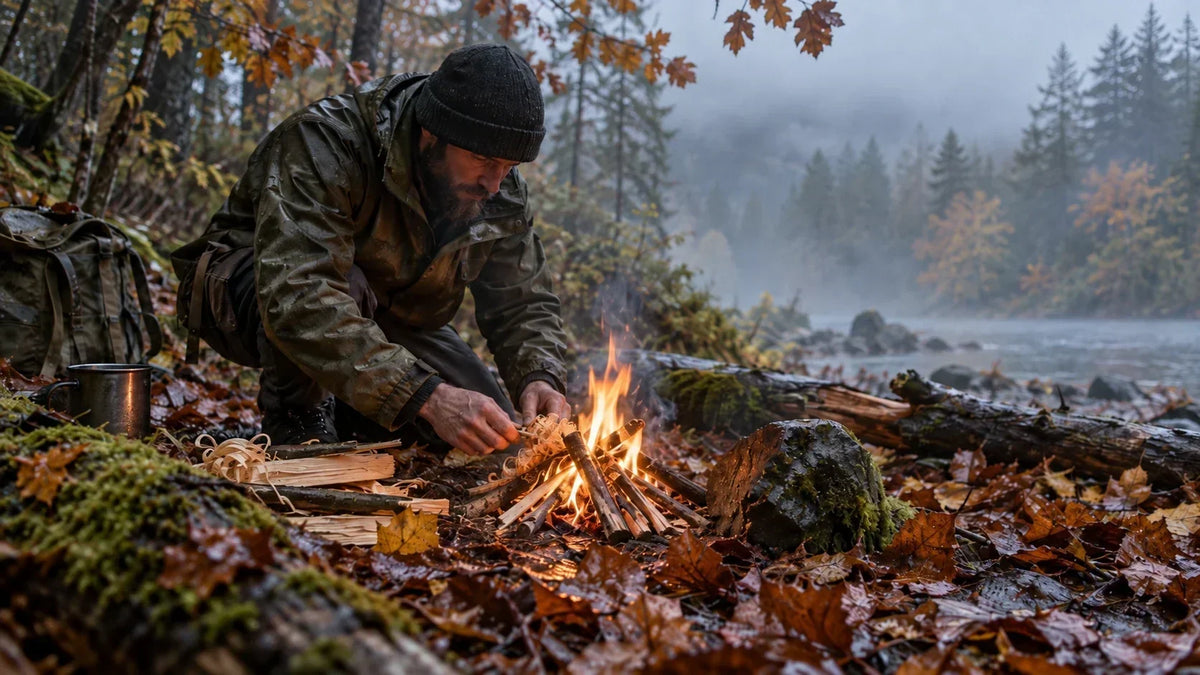
Autumn is the season that truly tests a bushcraft skill: lighting a fire when everything is damp. In summer, almost any method works. In autumn—rain, dew, waterlogged wood—only a rigorous technique makes the difference. Here is how to go about it, and how a well-chosen outdoor knife contributes directly to it.
Damp wood is not the problem you think it is
The classic mistake is looking for wood that is dry on the surface—virtually impossible to find after several days of rain. The right approach: wood is rarely damp to the core, even when its bark is soaked. This is where the knife becomes the key tool, not just an accessory.
The 4-step method
1. Find standing deadwood, never on the ground
Wood on the ground constantly absorbs ambient moisture. Deadwood that is still standing (dry branches broken off at head height, small deadwood caught in trees) is significantly less waterlogged, even after several days of rain.
2. Split to reach the dry core
Once a log or thick branch is retrieved, batoning allows access to the dry heartwood by splitting the section. This is the most crucial step in damp weather—without it, reliable ignition is impossible.
3. Reduce into fine shavings and sized sticks
Split wood is then cut into very fine shavings (for tinder), then into sticks of increasing diameter (pencil, finger, thumb) to build the fire structure gradually.
4. Light with a firesteel rather than a match
In damp weather, a firesteel remains reliable even when wet, unlike matches or a lighter whose gas may struggle to ignite in air saturated with moisture. The shower of sparks produced directly ignites the fine shavings prepared in the previous step.
The role of the knife in this method
Two TB-Outdoor models incorporate features designed specifically for this use:
- Maraudeur® — the spine of the blade features a thumb retention area that can also serve as a scraper for a firesteel, in addition to its batoning capability thanks to its full-tang construction.
- Commandeur® — its instructions explicitly mention a grip for fire-starter use integrated into the handle, in addition to its "thumb lock" function.
- Vengeur® Molle — features its own replacement firesteel (€23), confirming that ignition is an integral part of its design.
Useful accessories for autumn
| Accessory | Use | Price |
|---|---|---|
| Fire-starter survival bracelet & Kevlar saw | Integrated firesteel + emergency saw, compact format | €22.50 |
| Kevlar saw | Cutting small wood without stressing the knife's edge | €9.50 |
| Vengeur® Firesteel | Replacement part for the Vengeur® Molle | €23 |
Frequent mistake to avoid
Trying to light a large damp log directly without an intermediate step. Fires in damp weather are built using three strictly observed fuel sizes: fine tinder (shavings), sized kindling, and only then larger logs—skipping a step is the number one cause of ignition failure in difficult conditions.
Frequently asked questions
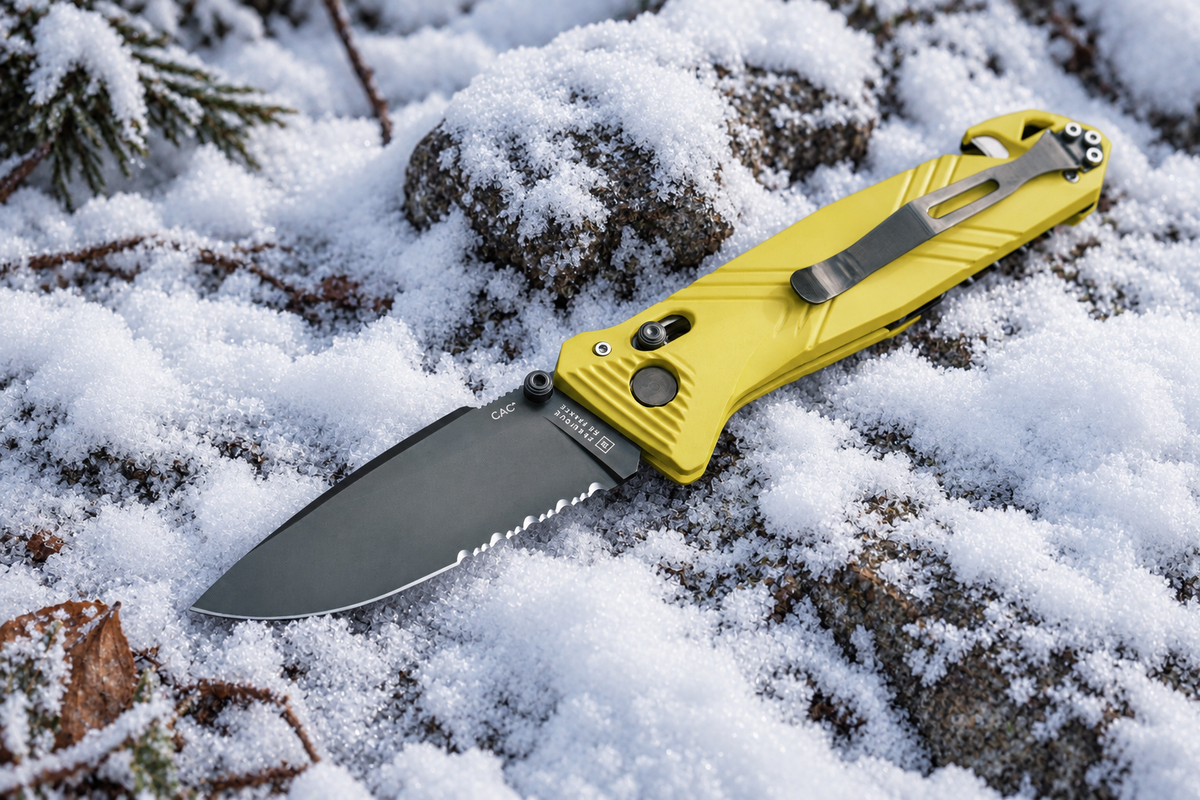
Is a folding knife like the C.A.C.® suitable for this method?
For fine cutting and scraping with a firesteel, yes. For the batoning necessary to split wood, no—you need a fixed blade like the Maraudeur® or the Commandeur®.
Does the firesteel really work in the rain?
Yes, that is precisely its advantage: unlike a match or gas lighter, the spark produced by friction is not affected by ambient humidity.
How long does it take to master this technique?
The method itself is learned quickly; it is the identification of the right wood (standing deadwood, dry at the core) that requires practice in the field.